
Introducing the Protocol Field Framework
Introduction
In an increasingly automated world, where AI systems operate at speeds faster than humans can often comprehend, the Protocol Field is a sense-making framework that aims to diagnose where human capacity is systematically undermined by the protocols and automated systems that structure social, economic and cultural interactions. It is a diagnostic framework for mapping a system's flexibility against its transparency. This approach helps to surface potential protocol debt - the natural drift toward brittleness that can make systems fragile and undermine human agency in an increasingly AI-mediated world.
This approach further treats a protocol not as a stable, independent object, but as an emergent sociomaterial practice, where its characteristics are revealed through its use in specific contexts 10, 15, 16. This aligns with the philosophical argument that context is not a passive background but an active force that creates coherence through the action of context-dependent constraints 7. These constraints intertwine actors, technologies and practices, making them mutually dependent and giving rise to the protocol's observable, enacted properties.
Methodologically, the framework engages in what Mol 9 calls praxiography - an analysis focused not on what a protocol is in the abstract, but on how it is done and enacted in the material world. To achieve this, the Protocol Field synthesises foundational concepts from the sociology of infrastructure 15, sociomateriality 10, and complexity science 13. It then operationalises these insights as a perspectival mapping tool built on the understanding that a protocol's characteristics emerge from an observer's position and their prior knowledge (cf. 1, 15). Its axes (Adaptability and Opacity) capture these experiential dimensions. The Opacity axis, for example, draws on Boisot's concept of codification, where a protocol's transparency is a function of how clearly its rules are structured.
Rather than competing directly with AI on its own terms (such as processing speed, training data and model parameter scale) the framework can help strategists to recognise and support the unique value of human acumen and practice. These approaches often rely on strengths such as flexibility, shared context and tacit understanding, which are vital for navigating ambiguity but are often overlooked in purely technical comparisons 1. It's a shift in perspective away from competing directly with AI and automation toward building a more resilient and collaborative coexistence.
The Protocol Field
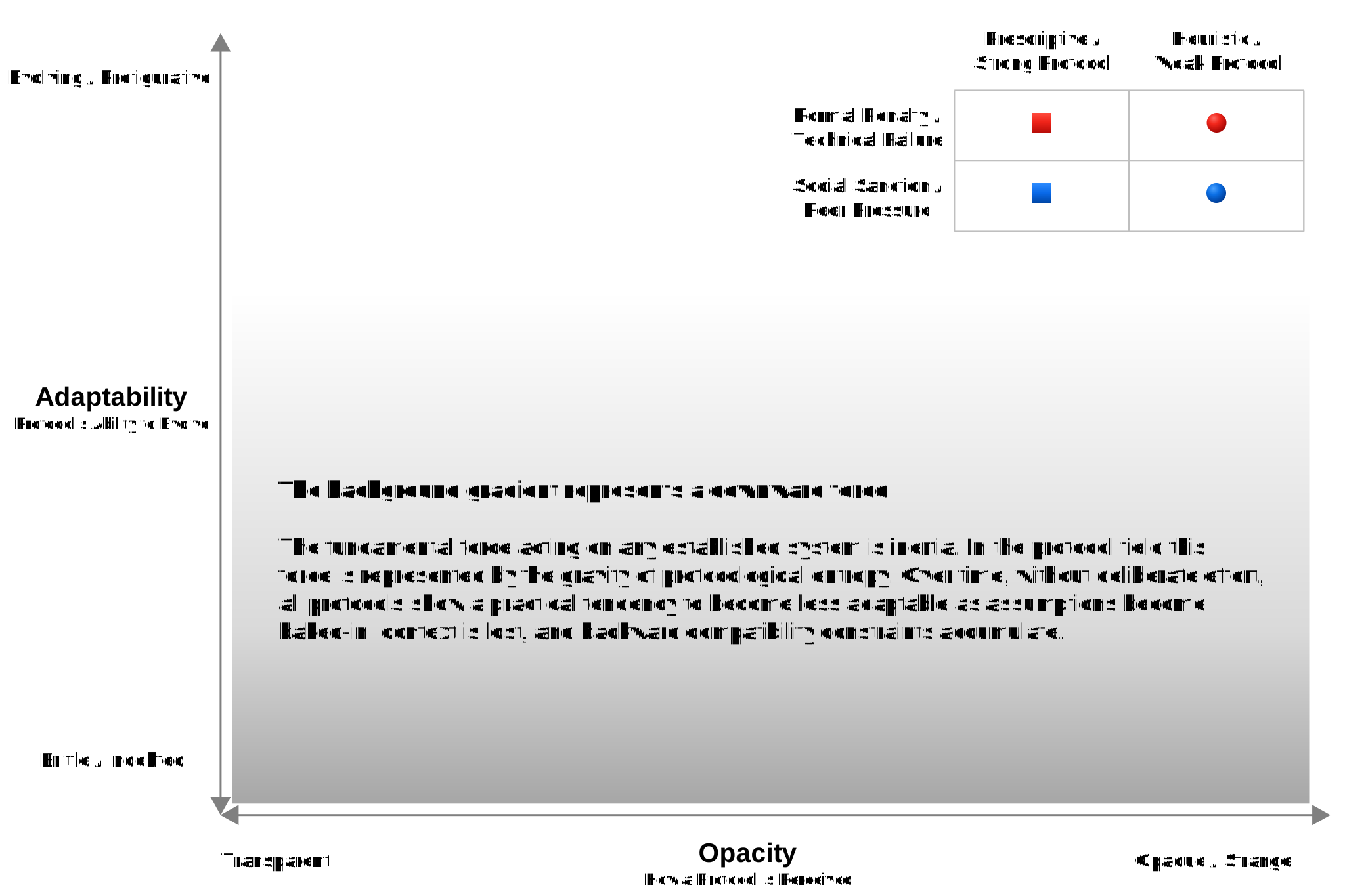
The Protocol Field is a visual framework designed to map and diagnose the dynamic state of protocols in practice. It provides a topological map for understanding the forces, risks and potential trajectories that affect any protocol over time. As a praxiographic framework, it posits that any protocol can be understood by analysing two experiential dimensions: Adaptability (its capacity to evolve versus its rigidity/brittleness) and Opacity (how transparent or strange its inner workings are perceived to be by its users).
Its background gradient represents a constant downward force acting on all protocols (see Framework Principles section).
The Axes
A protocol is situated on the field according to how it is enacted in relation to its environment and its users, which is assessed along two primary axes.
Adaptability
Adaptability assesses the observer's experience of a protocol's capacity for change and evolution. This axis reflects how flexible or constrained a protocol feels to those who use it, surfacing a critical trade-off between short-term efficiency and long-term effectiveness. Protocols optimised for efficiency in stable contexts often become rigid, sacrificing the adaptive capacity required for resilience in dynamic environments 12. This is a critical distinction, as a system's capacity for change is relational; what appears adaptive to a designer may feel rigid to an end-user who lacks the same context or skills. For instance, what a designer might see as a simple instruction can become a complex and frustrating barrier for a user, revealing a gap between the system's theoretical flexibility and its practical rigidity 15, 16.
-
Evolving / Prefigurative (Top)
Protocols high on this axis are flexible, adaptable and may even be designed to deliberately bring about a desired future (prefigurative protocols). They can respond to new information and changing contexts. -
Brittle / Indebted (Bottom)
Protocols low on this axis are rigid and resist change. They are often burdened by protocol debt - the accumulated weight of past decisions, backward compatibility constraints and outdated assumptions.
Opacity
Opacity assesses the observer's experience of comprehensibility within the protocol. Rather than an objective property, opacity acknowledges that transparency is fundamentally relational. This idea aligns with the media theory of McLuhan 8, who argued that technologies create new 'sense ratios', meaning what is clear to one cultural or cognitive standpoint may be opaque to another. This principle is especially relevant today, as human-AI interactions introduce novel forms of mediated cognition where the same system may appear transparent to the AI while remaining inscrutable to human observers 16.
-
Transparent (Left)
The protocol's internal logic and rules are clear and understandable to its users. -
Opaque / Strange (Right)
The protocol's workings are inscrutable, mysterious or alien. It may function, but how it functions is not clear, making diagnosis and intervention difficult.
The Legend
The framework uses a simple legend to classify a protocol's design intent, which provides a starting point for analysis independent of its position on the field.
Specificity
This describes the intended character of the protocol's rules.
-
Prescriptive / Strong Protocol (Square)
Classified as such when its rules are designed to be explicit, rigid and leave little room for interpretation. -
Heuristic / Weak Protocol (Circle)
Classified as such when its rules are designed as flexible guidelines that rely on user interpretation and adaptation.
Enforcement
This describes how a protocol breach is governed. Rather than viewing enforcement as a direct, forceful cause, the Protocol Field understands it through the lens of causality as constraint 7. Protocols do not simply cause outcomes; they structure the landscape of possibilities, making certain actions more or less likely and defining the consequences of moving outside established pathways. The typical consequences of a protocol breach are therefore a result of these structuring constraints:
-
Formal Penalty / Technical Failure (Red)
The breach is intended to result in a technical failure (for example, a compiler error) or a formal penalty (a legal sanction). This aligns with the concept of robust scaffolding, which uses rigid constraints to establish clear, predictable boundaries in ordered systems 17.
-
Social Sanction / Peer Pressure (Blue)
The breach typically results in social consequences, such as disapproval or loss of standing within a community. This corresponds to resilient scaffolding, which uses more permeable, heuristic-based constraints to facilitate interaction and adaptation within complex environments 17.
Framework Principles
The diagnostic potential of the Protocol Field emerges from several theoretical principles and their relationships.
Ontological Breadth and Diagnostic Tension
This breadth is intentional. In an AI-mediated world, the distinction between formal rules, informal practices, narratives, heuristics and technical systems is increasingly unstable. What begins as a weak protocol can harden into infrastructure, while formal protocols may be enacted loosely, symbolically or selectively.
The Protocol Field therefore adopts an intentionally expansive definition of protocol. This is not a claim that all protocols are equivalent, desirable or interchangeable. It is a modelling stance designed to support diagnosis under complexity. By treating all forms of structured interaction as protocols, the framework allows weak, informal, tacit and narrative protocols to be examined alongside strong, formal and technical ones without privileging either by default.
The framework does not rank or prioritise protocols. Weak protocols are not treated as inferior to strong protocols, nor are strong protocols assumed to be more legitimate. Instead, protocols are placed within a shared geometric space according to how they are experienced in practice. Their diagnostic value arises from position, movement and interaction, not from categorical superiority.
Holding multiple, sometimes contradictory protocol interpretations in tension is itself treated as a necessary capability for navigating complexity. The purpose of the Protocol Field is not to resolve these tensions prematurely, but to make them visible and reasonable so that interventions can be designed with awareness of trade-offs, constraints and unintended consequences.
The Entropic-like Force of Protocol Debt
The fundamental force acting on any established system is inertia. In the Protocol Field, this is represented as the gravity of protocol debt. This term is a direct adaptation of the 'technical debt' metaphor, originally conceived to explain how shipping a product based on an incomplete understanding incurs an ongoing cost that slows subsequent development 2. The Protocol Field framework, however, conceptualises this debt more broadly. It accounts not only for the passive, entropic-like drift toward brittleness but also for the deliberate adoption of an indebted protocol out of perceived necessity. Such a decision effectively treats the protocol as a good-enough solution to a pressing problem, deferring the true cost of its compromises until its inherent fragility is inevitably exposed by future stressors.
This downward pull can be understood as an energy gradient that must be actively managed. Without a deliberate input of energy to counter this force, the path of least resistance for the system will inevitably lead toward brittleness 14. This concept aligns with the work of Juarrero 7 on sedimentation and entrenchment, which describes how constraints that once provided stability can become deeply embedded, making the system resistant to change even when the original context has shifted. Over time, without a deliberate input of energy and effort, all protocols show a practical tendency to become less adaptable as assumptions become sedimented and context is lost 7 , 16.
How Protocol Debt Accumulates
Protocol debt can accrue through several specific mechanisms:
-
Assumption Embedding
Early design decisions become invisible assumptions that later developers or users cannot see or question. What was once a conscious choice becomes an unexamined constraint.
-
Context Loss
The original reasons for protocol design fade from institutional memory. Without understanding why rules exist, people cannot adapt them appropriately when conditions change.
-
Compatibility Constraints
Each version of a protocol must work with previous versions, creating layers of legacy support that make change increasingly difficult and expensive.
-
Exception Accumulation
Special cases and workarounds multiply over time, creating complex interdependencies that make the system fragile and hard to modify.
-
Skill Atrophy
As protocols become more automated or abstracted, human understanding of the underlying processes diminishes, making informed intervention more difficult.
Justification for Experiential Axes
These experiential dimensions enable comparative analysis across different participant perspectives. By mapping how the same protocol functions in completely different ways for different participants (e.g., human, institutional or algorithmic), the framework reveals fundamental disconnects in practice. This approach moves beyond simply comparing different opinions about a protocol to showing how it behaves like multiple, distinct systems at the same time 9. While ethnographic studies have long identified such perspectival divergences 15, the Protocol Field offers a way to rapidly map and diagnose them without requiring deep ethnographic engagement, making the insights accessible to practitioners. This approach acknowledges that protocols are enacted not as objective entities but as relational configurations that simultaneously constrain and enable action depending on the observer's position within the system, a perspective that aligns with Gibson's 3 ecological view of the animal-environment relationship.
Hierarchy and Perspectival Gaps
Complex systems are often hierarchical in nature. This hierarchical structure allows for stable, nearly decomposable subsystems to evolve and interact 11. The Protocol Field framework does not approach hierarchy structurally but instead provides a diagnostic method for tracing how hierarchies work in practice - their experiential consequences.
For instance, a protocol designed by senior leadership may be perceived as Evolving and Transparent at that level by embodying strategic flexibility. However, for frontline practitioners responsible for its implementation, the same protocol may be experienced as Brittle and Opaque. This occurs because hierarchical levels create informational and contextual boundaries. The original design intent and context decay as instructions move down the hierarchy, while the practical challenges and tacit knowledge from the frontline fail to transmit back up.
This dynamic is a key driver of protocol debt. Decisions made at one level of a hierarchy become unexamined constraints for another, accumulating a debt that manifests as organisational rigidity and systemic risk. The Opacity axis, in particular, makes the consequences of this hierarchical information loss visible. Therefore, rather than treating complexity as non-hierarchical, the framework provides a method for tracing the effects of hierarchical arrangements by mapping the topological gap that emerges between how protocols are enacted by actors at different levels.
Dynamic Mediation Relationships
Building on Marshall McLuhan's 8 insight that the medium is the message, the Protocol Field reveals that the locus of mediation is not fixed - it shifts between two modes of mediation:
-
Protocol as Mediator
The protocol itself becomes the constraining and enabling environment. Like how written text protocols shape thought patterns or how algorithmic feeds shape attention, the protocol operates as the medium-message that structures action 8.
-
Protocol as Field
The protocol becomes transparent infrastructure that creates a field of potential action. Like fluent speakers using language to communicate rather than being constrained by grammar rules, the human actor operates through rather than within the protocol. In this mode, the protocol functions less as a static object and more as a persistent pattern imposed upon a flow of activity, shaping interactions without being the explicit focus of them 5.
Skilled practitioners can consciously shift between these mediation modes. Manual craft typically involves protocol as transparent field (the craftsperson operates through tools), while supervisory craft involves protocol as dynamic mediator (the practitioner shapes the mediating environment). Protocol literacy involves recognising and navigating these mediation shifts rather than just choosing between protocol types.
Enforcement Dynamics Over Time
The mode of enforcement significantly affects how protocols evolve:
-
Red (Formal / Technical) Enforcement tends to create rigid boundaries but clear feedback. When protocols fail, they fail obviously and immediately. This can help sustain a protocol's resilience by forcing regular attention to system maintenance. However, formal enforcement can also accelerate protocol debt by making changes expensive and risky.
-
Blue (Social) Enforcement creates more flexible boundaries but subtler feedback. Social protocols can adapt gradually through community consensus, but they can also drift unconsciously or become opaque to newcomers. Social enforcement is often more resilient but less predictable than formal systems.
Protocols often shift enforcement modes over time. Informal social practices may become formal rules (blue to red), while rigid formal systems may be replaced by flexible social norms (red to blue).
Applying the Protocol Field
There is a three-step process:
-
Plot the Protocol
First, classify the protocol's design intent to choose the correct icon from the legend. Then, assess how it is enacted from a primary perspective by situating that icon on the field. To facilitate a multi-perspectival analysis, the framework enables the plotting of icons to represent how the protocol is enacted from alternative viewpoints.
-
Diagnose the Position
A protocol's position on the field invites an initial diagnosis. For example, a protocol enacted in the bottom-right region (Brittle and Opaque) suggests a high-risk black box system. This initial diagnosis can be deepened through the use of a Value Probe, a technique for explicitly analysing the risks and benefits as experienced from each plotted perspective.
-
Map Trajectories
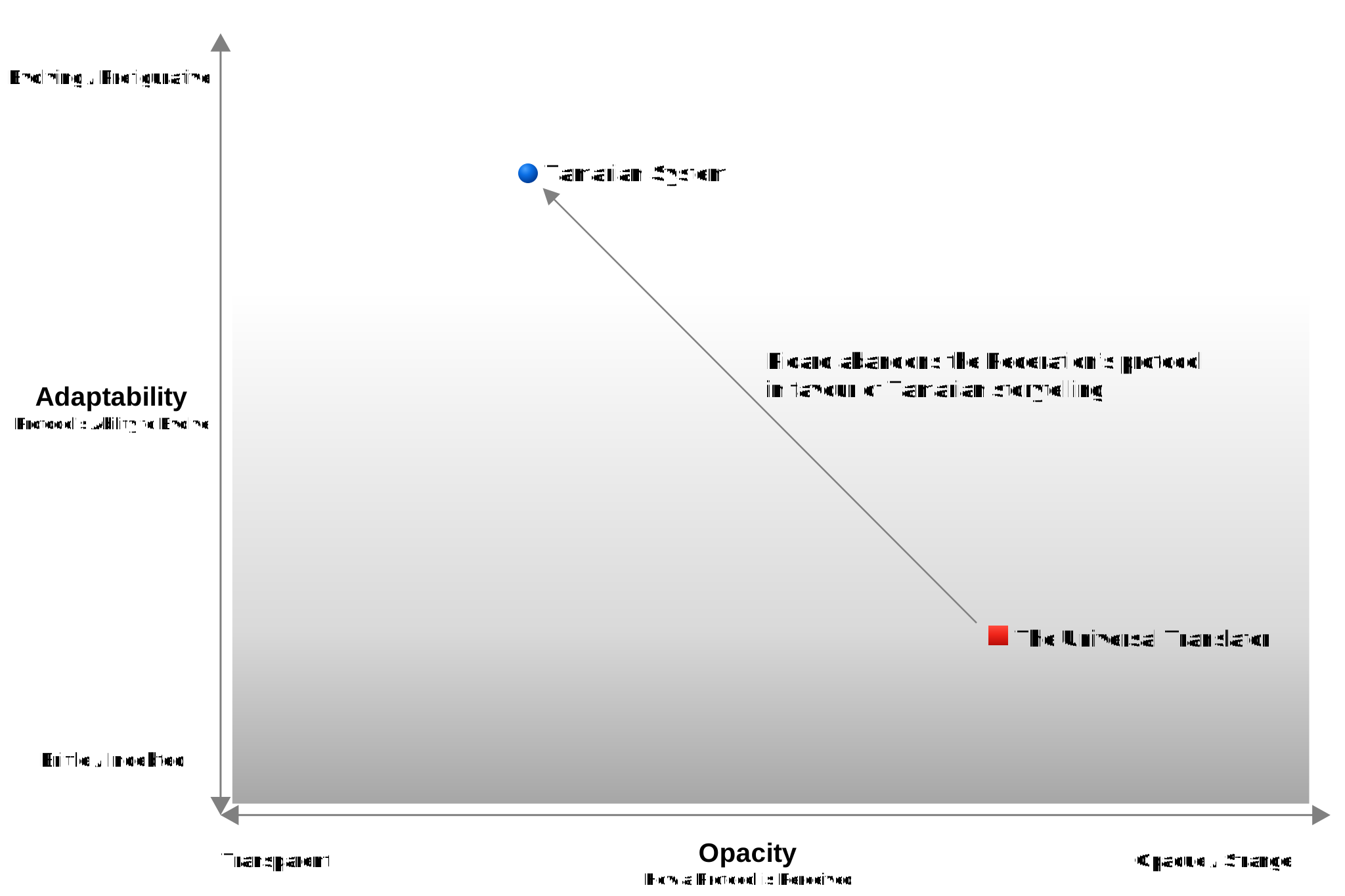
The framework's main power comes from mapping movement over time. By plotting a protocol's historical path, its currently enacted position and its likely future drift (due to the gravity of protocol debt), you can begin to understand its lifecycle and the forces acting upon it. The Darmok example on the map shows this, illustrating a trajectory from a failing protocol (the Universal Translator) to a successful one (the Tamarian System).
Common Protocol Patterns
Through mapping various protocols, some recurring patterns begin to emerge:
-
The Codification Trap
Successful informal practices get codified into formal rules but lose their adaptive capacity in the process. The protocol moves from top-left (adaptive and transparent) to bottom-left (rigid but transparent), often ending up bottom-right (rigid and opaque) as complexity accumulates.
-
The Automation Drift
Manual processes get automated for efficiency, but the automation becomes opaque over time. The protocol moves from left to right on the opacity axis while often becoming more brittle. Eventually human operators lose the skills needed to intervene when the automation fails.
-
The Innovation Cycle
New protocols often start in the top-right (adaptive but opaque) as innovators experiment with unclear methods. Successful innovations gradually become more transparent as they're documented and taught, moving toward top left. However, success often triggers codification, starting the drift toward brittleness.
-
The Emergency Response
Crisis situations can temporarily reverse protocol debt by forcing rapid adaptation. Brittle protocols in the bottom regions may suddenly jump upward as emergency conditions override normal constraints and enable rapid change.
Understanding these common and potentially other patterns helps contextualise and anticipate where protocols are likely to move and what interventions might be possible and effective.
Examples
1. Star Trek Darmok Episode
The Federation's Universal Translator is a strong protocol-mediated system that fails because its core assumptions are incompatible with the Tamarian language. This results in 100 years of repeated failure and conflict. The challenge illustrated in the episode is not merely a fictional conceit; it highlights a classic problem in communication theory and remains a subject of modern computational linguistics research, with recent studies attempting to build AI models capable of translating Tamarian's metaphor-rich structure 6. The breakthrough in the story happens when Jean-Luc Picard shifts from a protocol-mediated to an actor-mediated approach by adopting the Tamarian storytelling method.
2. Scientific Validity
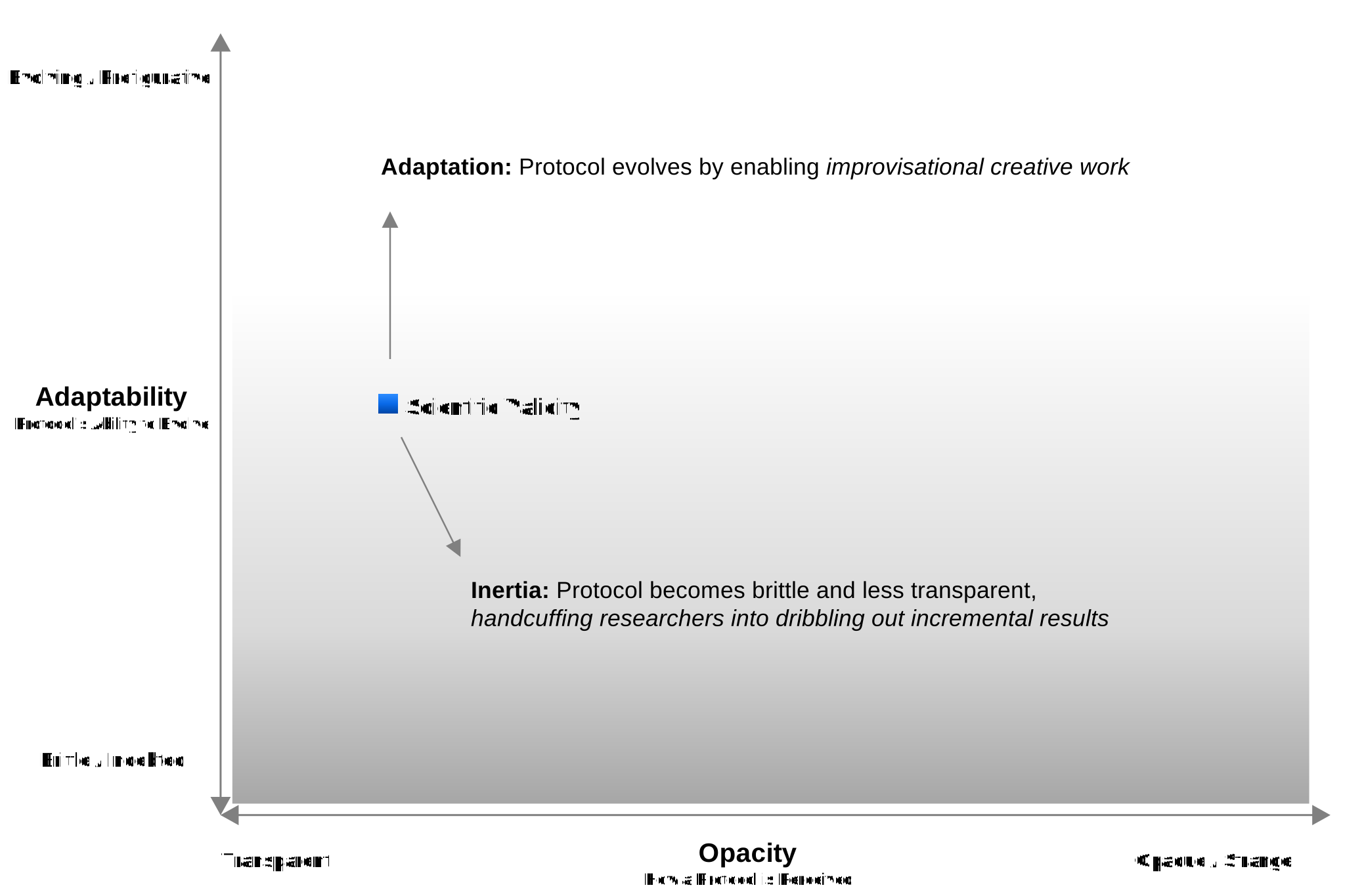
Scientific validity is based on defined rules so everyone can agree on a baseline. Academic/research creativity can happen by pushing against these rules but risks social sanction from peers and rejection from journals. Its positioning on the Protocol Field suggests scientific validity exists in a state of dynamic equilibrium. This opens the question: can similar patterns be found by mapping the protocols of other disciplines?
3. Escaping the Tyranny of the Explicit
The need to diffuse knowledge leads to codification that creates transparent but often brittle texts/protocols. What gets lost in this compression is demonstration bandwidth - a concept inspired by Boisot's bandwidth effect 1 that makes storytelling adaptive rather than static. This includes contextual knowledge, body language, tempo, audience feedback and other non-verbal cues. Strong protocols preserve explicit rules but not the tacit knowledge of how and when to bend or break them.
Now, with programming by demonstration and the recent capabilities of large language models (LLMs) to accommodate very large context windows, demonstration bandwidth may provide a means of escaping this tyranny. By populating context windows with clues, hints, analogies, metaphors and other layers of examples/demonstrations (weak protocols) the adaptive contextual richness of oral transmission could be preserved.
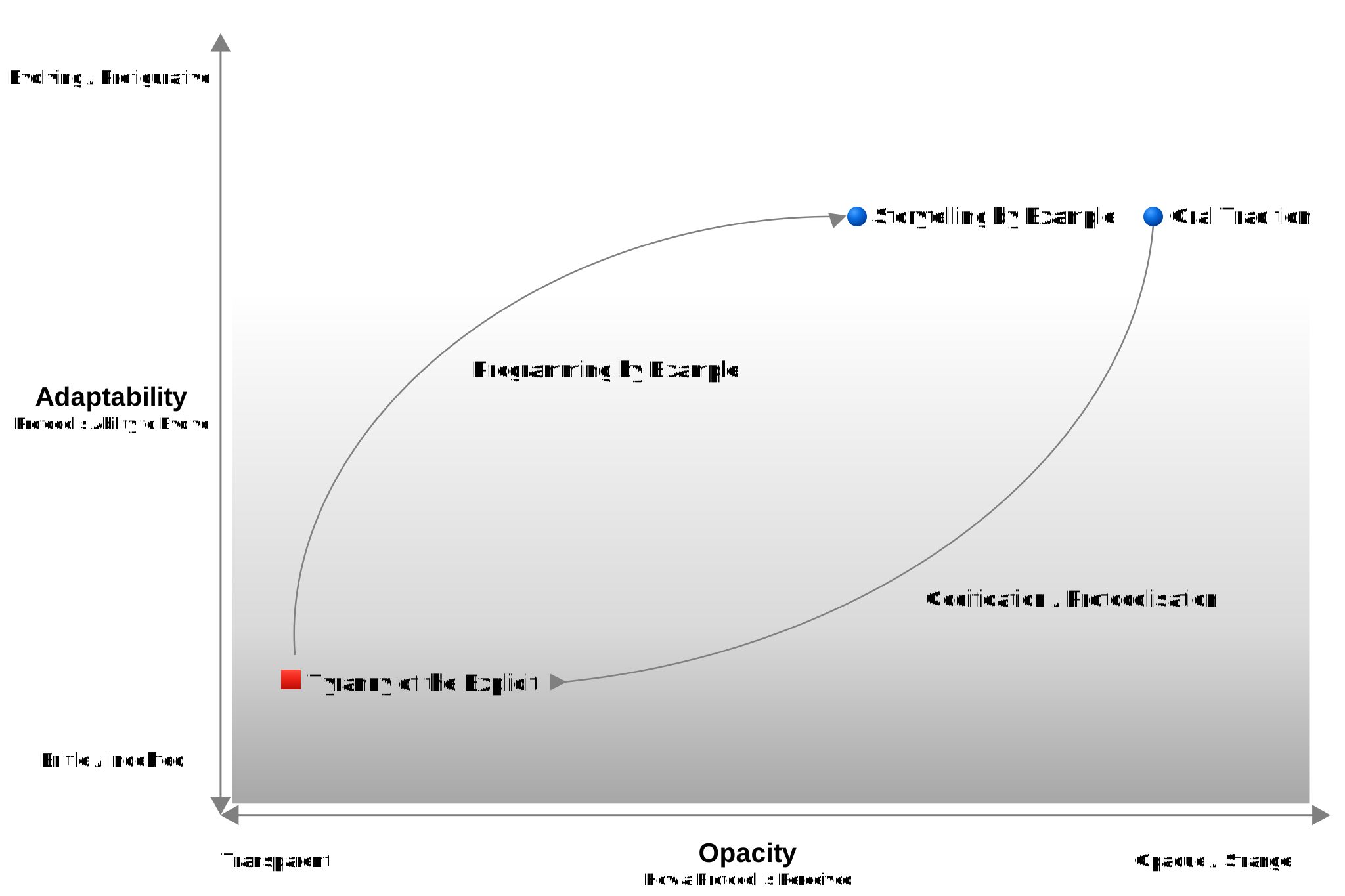
On the Protocol Field, this is represented by a return to the contextual storytelling space, where protocols emerge from assemblage rather than prescription. It's not about nostalgia, but technological capacity matching the bandwidth requirements of prefigurative protocols.
This example also reveals an ongoing transformation in software development from manual craft (developers writing code directly) to supervisory craft (developers guiding AI systems). By mapping this transition, we can anticipate that new weak protocols for human-AI collaboration will emerge in ambiguous domains, while strong protocols will dominate well-codified tasks. This anticipatory insight enables proactive development of demonstration bandwidth capabilities and protocol literacy before critical human skills atrophy.
Note: The Tamarian example demonstrates how the same protocol can appear opaque from one perspective (Federation) and transparent from another (participant community). This perspectival dependency isn't a bug in the framework - it is a feature. The Protocol Field is a sense-making framework for specific contexts, not a universal classification system. This multiple positioning adds an important dimension to the framework by highlighting how observer position affects protocol perception.
4. Human-AI Coevolution
This Protocol Field plots the same underlying protocol from two distinct observer positions. The protocol is the operational logic of a hypothetical open-ended AI system. From its own internal perspective, the AI operates in the top left of the field; its processes are functionally transparent to itself, and the system is inherently adaptive. From the human oversight perspective, however, this same evolving system drifts rightward. Its capacity for evolution is evident, but its methods and protocols become increasingly opaque, resembling an evolving black box.
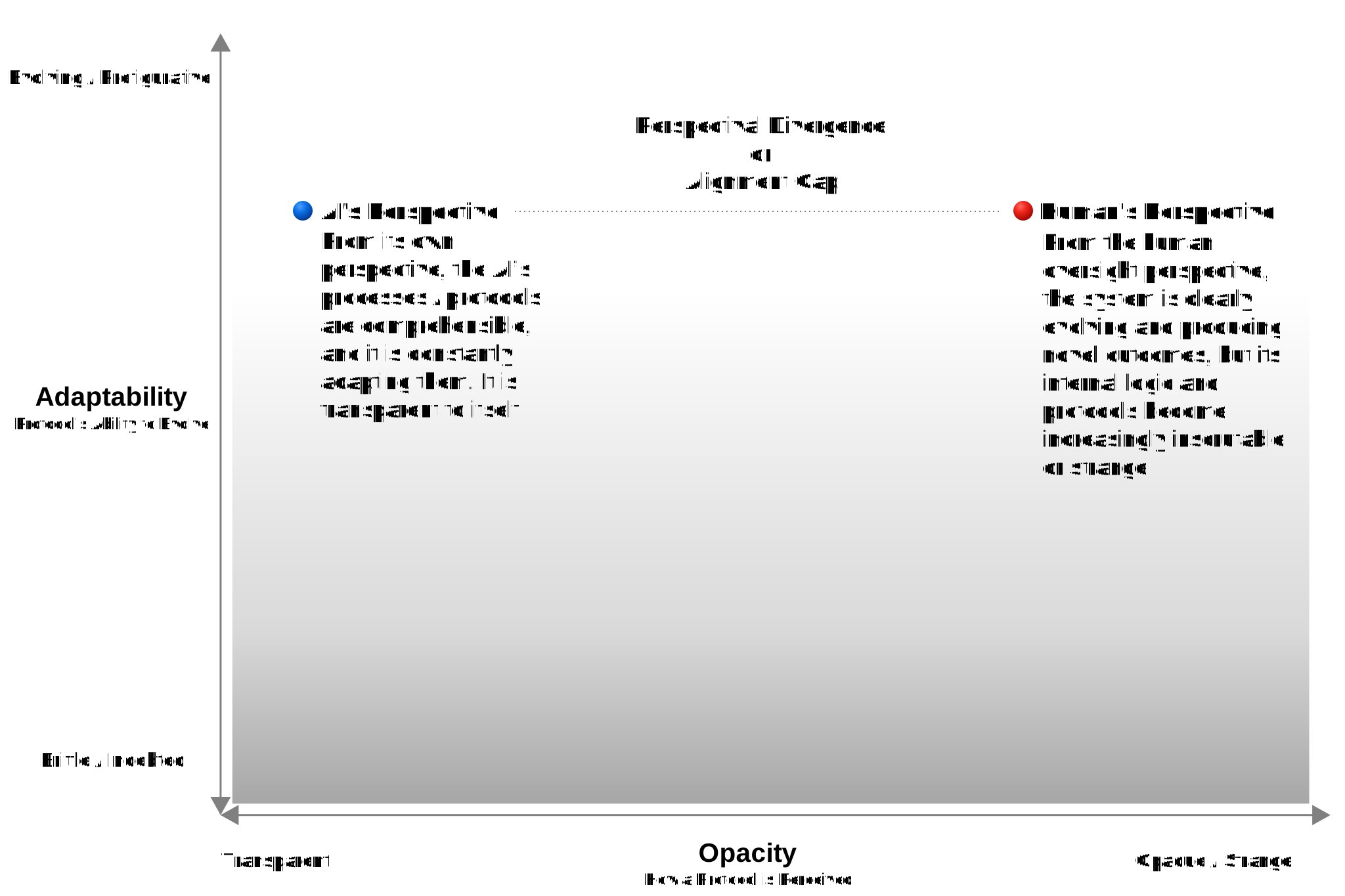
This perspectival divergence makes effective supervisory craft an increasingly difficult and skilled undertaking. The nature of this difficulty can be considered through the lens of McLuhan's concept of narcissus narcosis 8 - the cognitive numbness that can occur when humans become distracted by their own technological extensions. As the human-AI gap widens, this "narcosis" poses a direct threat to the integrity of supervisory craft. It creates the risk that the human oversight role degrades into a performative formality. In other words, the role becomes a ritualised process providing the illusion of control while the automated system operates on its own inscrutable terms.
Value Probe
| Perspective | Region | Adaptability Value (Risk/Benefit) | Opacity Value (Risk/Benefit) | Core Tension |
|---|---|---|---|---|
| Human Oversight Team | Top-Right (Evolving but Opaque) | Benefit: The system is improving and generating novel outcomes without requiring direct human intervention. | Risk: The system's logic is increasingly inscrutable, turning human oversight into a performative formality. | The team benefits from the AI's autonomous evolution but risks losing the ability to understand or meaningfully control it. |
| AI System (Internal) | Top-Left (Evolving and Transparent) | Benefit: The system is fulfilling its core function by continuously adapting its internal protocols to meet its objectives. | Benefit/Neutral: The system is perfectly transparent to itself, which is a necessary condition for its own operation. | The system's internal drive for coherent self-adaptation creates an external comprehensibility gap with its human supervisors. |
| Institutional / Legal Dept. | Top-Right (Evolving but Opaque) | Risk: The system's constant, unpredictable evolution creates a shifting landscape of liability and makes it impossible to guarantee compliance with static regulations. | Risk: The inability to explain why the AI made a certain decision makes any legal defence against a bad outcome incredibly difficult. | The organisation benefits from the AI's high performance but is simultaneously exposed to an unquantifiable and potentially catastrophic legal risk. |
5. Physical Embodiment of Protocols
Across the field space, protocol embodiment is represented as a shift in characteristic from explicit material forms to distributed, emergent assemblages as assumptions become embedded, context becomes implicit and coordination mechanisms evolve toward emergent self-organisation. This form of embodiment aligns with the principles of complex adaptive systems, in which the behaviour of the whole emerges from local interactions between diverse, bounded agents - a phenomenon known as distributed control 5. This topology allows for gradual transitions between embodiment regions, protocols that span boundaries and movement across the field space. The four embodiment types represent patterns, not discrete categories, each with distinct physical manifestations and intervention requirements.
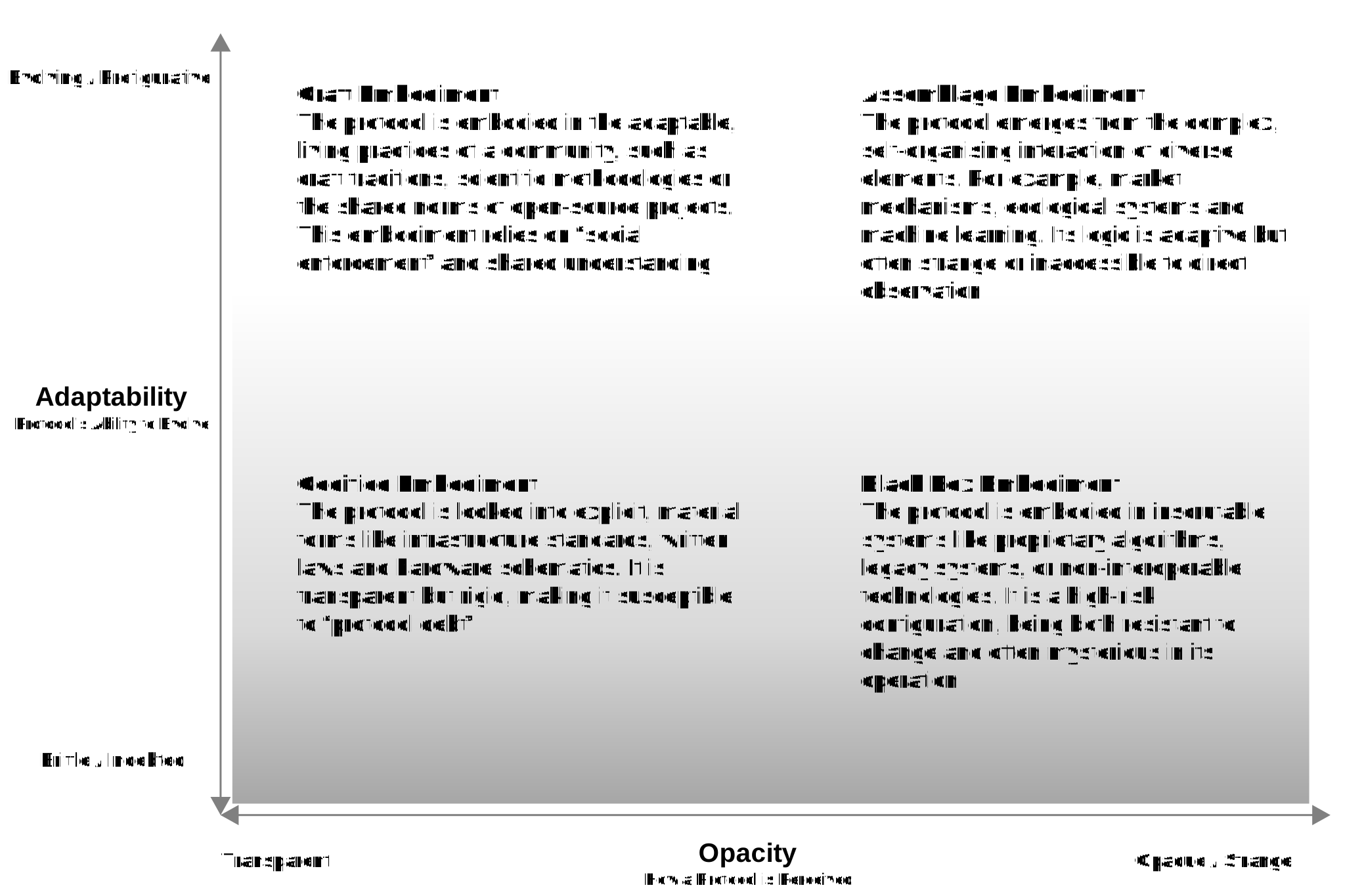
Music offers a good example of spanning protocol patterns. Popular music seems to be more about a shared ethos rather than abstract symmetries or mathematical determinism. While musical instruments, scales and tuning provide a structured set of possibilities for action (what Gibson 3 termed affordances) that represent a form of Codified Embodiment, musical evolution is more opportunistic, with musicians borrowing thinly from other artists (Craft shifting to Assemblage). A single musical tradition can simultaneously embody rigid material constraints (instrument design/construction), transparent community practices and self-organising scenes. In other words, protocols operate across the field space rather than in fixed categories.
6. Ethical Case
Scenario
An organisation is implementing a new Anonymous Workplace Misconduct Reporting protocol. The goal is to protect whistleblowers. Here, Opacity is not a bug; it is the central feature that enables safety and encourages reporting.
Applying the Protocol Field
The protocol is new, and its norms are still forming, so it's Evolving. Its core function relies on anonymity, so it's Opaque. It's plotted in the Top-Right. The cognitive hook immediately screams adaptive but mysterious, a potential risk.
Value Probe
This is where initial judgment is calibrated, and the ethical tension is assessed.
| Perspective | Region | Adaptability Value (Risk/Benefit) | Opacity Value (Risk/Benefit) | Core Tension |
|---|---|---|---|---|
| Employee / Reporter | Top-Right | Benefit: Norms can evolve based on feedback to make reporting safer. | Benefit: Anonymity provides critical protection from retaliation, which is the only way to ensure reports are made. | The system's perceived trustworthiness is directly tied to its opacity. |
| HR / Investigator | Top-Right | Risk: Shifting norms make consistent investigation difficult. | Risk: Anonymity makes it hard to verify claims or gather follow-up information, risking flawed investigations. | We need reporters to trust the system's opacity, but that same opacity hinders our ability to reach a just conclusion. |
| Person Being Accused | Top-Right | Neutral: Irrelevant compared to the core issue. | Risk: Opacity creates a situation where they cannot face their accuser, making a defence difficult and risking reputational ruin from anonymous, potentially malicious, claims. | The shield that protects the reporter is a sword that threatens the accused, regardless of guilt. |
7. Discursive Debate
Scenario
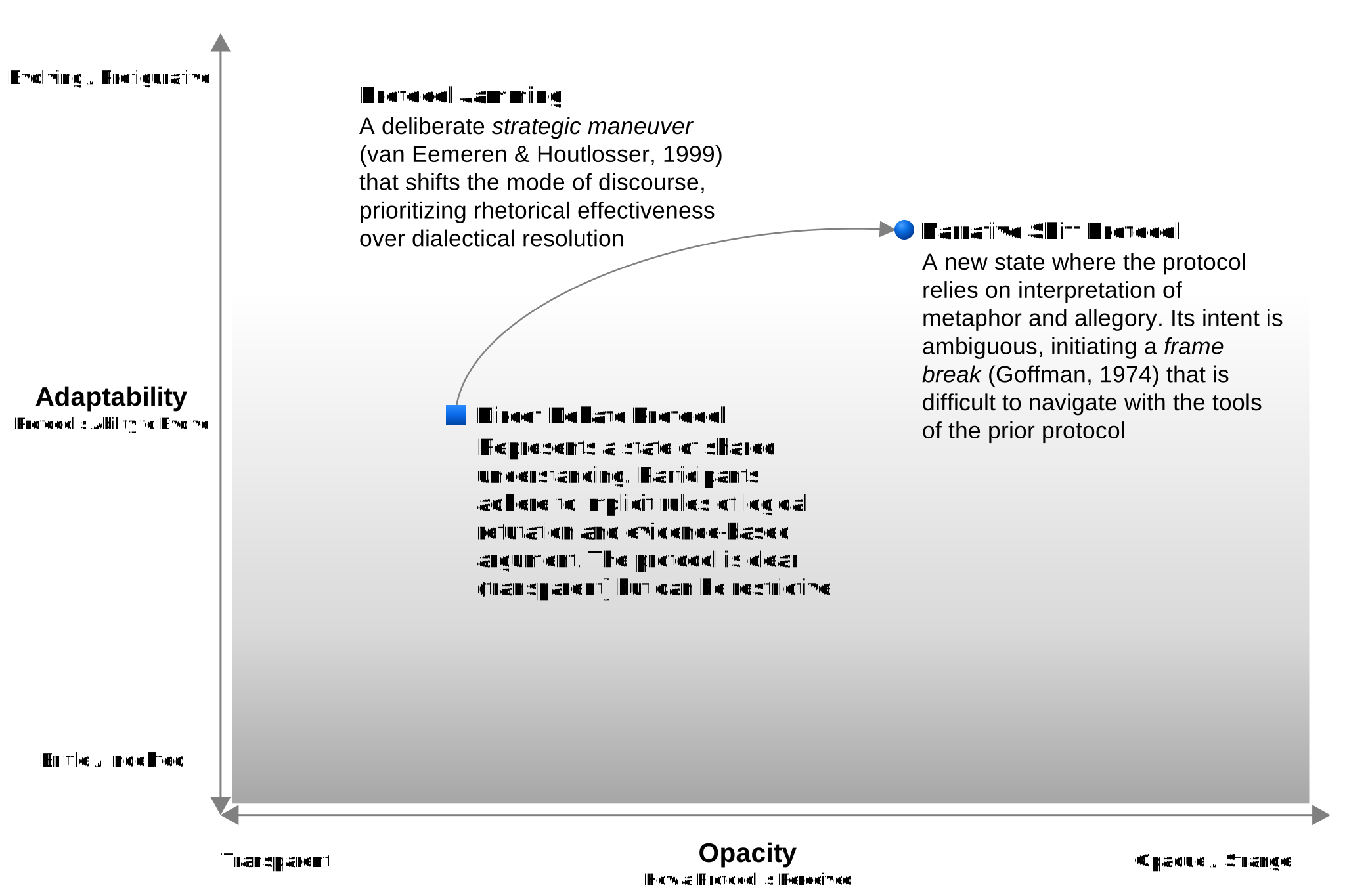
A technical or academic debate is underway, operating under an implicit protocol of direct, evidence-based argumentation. This protocol is not a stable, independent object but is revealed to be an emergent sociomaterial practice enacted by its participants (cf. 10). Participant A (the Challenger) introduces a formal framework (the Protocol Field) to structure the debate. In response, Participant B (the Jammer) sidesteps this framework by shifting the entire medium of discussion from analytical argument to allegorical storytelling. This manoeuvre initiates what Goffman calls a frame break 4 - a disruption of the shared definition of a situation, which makes the tools of the prior protocol difficult to use.
Applying the Protocol Field
This interaction reveals two distinct protocols and a trajectory between them. The framework helps map that a protocol's ontology is not a given but is instead brought into being and sustained through the day-to-day sociomaterial practices that enact it 9.
Value Probe
This is where initial judgment is calibrated, and the ethical tension is assessed.
| Perspective | Region | Adaptability Value (Risk/Benefit) | Opacity Value (Risk/Benefit) | Core Tension |
|---|---|---|---|---|
| The Jammer (Participant B) | Top-Right | Benefit: Escapes a difficult dialectic position. | Benefit: Avoids making a direct concession. | They successfully evolve the conversation but risk damaging trust. |
| The Challenger (Participant A) | Top-Right | Risk: Their structured approach is disrupted. | Risk: Forced to decode an ambiguous narrative. | Their analytical tools are rendered less effective by the modality shift. |
| Neutral Observer | Top-Right | Benefit/Risk: The debate has become more complex and potentially richer, but also less clear. | Benefit/Risk: The shift reveals deeper values but obscures a clear resolution. | The debate's protocol is revealed as an unstable field of power. The Jammer has effectively shifted from a simple domain to a complex one, making a probe-sense-respond approach necessary 13. |
Strategic Insight
This example demonstrates that discursive encounters can be governed by protocols that can be contested. The protocol jam is a deliberate strategic manoeuvre that shifts the mode of discourse, prioritising rhetorical effectiveness over dialectical resolution 18. This rhetorical strategy highlights that the locus of mediation can shift 8, and the shift from analytical to narrative prose is not just a change in style but a change in the protocol itself. Conversations are subject to the same forces of protocol debt, strategic adaptation and perspectival opacity as any other system. The Protocol Field provides a shared language to diagnose these hidden risks and facilitate conversations about them.
Further Research
- Formalise the Value Probe as a structured method. This would involve researching and adapting established techniques. The goal is to develop a repeatable process that allows practitioners to explicitly map conflicting values, risks and benefits that emerge from a protocol's enactment across diverse stakeholder perspectives.
- Further investigate prefigurative protocols and their role in shaping AI-mediated futures.
- Develop anticipatory protocols for preserving human agency in emerging craft transformations.
-
Conduct small-scale, qualitative community pilot workshops with diverse stakeholders (e.g., designers, managers, practitioners and directly affected communities). The primary
objectives of these pilots would be to:
- Assess the effectiveness of the Protocol Field's diagnostic capabilities by testing its axes and Value Probe in real-world AI and organisational contexts.
- Build a library of protocol patterns and intervention strategies (e.g., mitigating opacity risks, countering protocol debt and fostering protocol literacy).
Appendix 1: Frequently Asked Questions
1. Foundational Concepts
1.1 What is the Protocol Field?
The Protocol Field is a visual framework for diagnosing the dynamic state of any protocol-based system, from technical standards to organisational routines and cultural norms. Its purpose is to go beyond static classification to map the forces, risks and potential trajectories that affect a protocol over time, enabling users to generate strategic insights.
1.2 What does it mean to say a protocol is enacted in practice?
The framework uses the term enact to analyse the crucial gap between a protocol's design and how it works in the real world. To say a protocol is enacted means its reality is brought into being through the specific, concrete practices of its use. The reality of the protocol and the practice of using it are inseparable.
A modern musician using a Digital Audio Workstation (DAW) offers a good metaphor:
- The DAW software is the formal, prescriptive protocol. It has fixed rules, technical standards (like MIDI) and built-in constraints. It is not, by itself, music.
- Music is enacted when a musician uses the DAW. One musician might use it to create a perfectly quantized, rigid electronic track, enacting a reality of precision and order. Another might use the same software to record loose, off-the-cuff acoustic takes, intentionally ignoring the grid and pushing the software's limits. A third might discover that a software bug creates a fascinating new sound, enacting a reality of happy accidents and emergent properties.
Each of these is a different, valid enactment that constitutes the reality of the DAW for that user. The Protocol Field focuses on these enactments because they reveal what a protocol is in practice. This focus helps diagnose the critical gaps between the intended design and the living, multiple realities of the protocol as it is performed by people and other systems. This is where hidden risks and opportunities for innovation can be found.
1.3 What problem does it solve?
It addresses the challenge that established protocols often become brittle, opaque and fragile over time in ways that are hard to see until it's too late 15. The framework provides a method for making these hidden risks visible, explaining why systems decay and why adaptability is so difficult to maintain.
1.4 Who is this framework for?
It is for strategists, managers, designers and anyone involved in creating or managing complex systems. It provides a shared language and visual canvas to diagnose the health of technical and human systems, identify risks and facilitate conversations about strategic interventions.
1.5 Some definitions, particularly within complexity frameworks like Cynefin, treat protocols as intentionally designed systems while emergent behaviours are called habits 13. How does the Protocol Field handle this distinction?
This is an important distinction and gets to the purpose of the Protocol Field. While it may be useful in many contexts to separate deliberately designed systems from emergent ones, the Protocol Field is built on the premise that this boundary is not a fixed boundary but a dynamic and porous boundary.
The premise is that behaviours constantly cross this line:
-
Emergence becomes Design
Successful informal practices and community habits are often formalised into explicit rules.
-
Design becomes Emergence
Conversely, designed protocols decay over time. Through protocol debt, context is lost, and rules become unthinking habits, drifting from their original intent.
Therefore, the Protocol Field is not just for mapping designed systems. It is a sense-making tool. Specifically, to diagnose and interpret experiential perceptions of the lifecycle, including the emergence of habits, their codification into protocols and their eventual decay back into taken-for-granted routines. While emergence defies full predictability, the Protocol Field maps observable patterns in this "messy middle" that narrower, category-based definitions may bracket out, treating protocols as relational and provisional rather than definitively bounded.
1.6 How does the Protocol Field help anticipate future developments?
The framework's temporal mapping capabilities may make it valuable for anticipating protocol evolution in rapidly changing domains. For example, as knowledge work shifts from manual craft (direct manipulation) to supervisory craft (guiding AI systems), the Protocol Field helps identify which protocols are likely to emerge, persist or become obsolete. By mapping current trajectories and understanding the forces of protocol debt, practitioners can anticipate where human agency might be systematically undermined and develop countermeasures before critical capacities are lost.
2. Core Components
2.1 What do the two axes represent?
The axes define a protocol's dynamic stance - its relationship with its environment and its users.
-
The vertical axis is Adaptability
This situates the "Protocol's Ability to Evolve". At the top is Evolving / Prefigurative, representing protocols that are flexible and can adapt to change. At the bottom is Brittle / Indebted, representing rigid protocols burdened by protocol debt.
-
The horizontal axis is Opacity
This situates "How a Protocol is Perceived". On the left is Transparent, where the protocol's logic is clear to users. On the right is Opaque / Strange, where its inner workings are inscrutable or mysterious.
2.2 What do the plotted icons and their colours mean?
The icons represent the design intent of a protocol.
Shape represents Specificity:
- A Square denotes a Prescriptive / Strong Protocol with rigid, explicit rules.
- A Circle denotes a Heuristic / Weak Protocol with flexible guidelines that require user interpretation.
Colour represents Enforcement:
- Red denotes Formal Penalty / Technical Failure, where a breach results in a technical error or a formal sanction.
- Blue denotes Social Sanction / Peer Pressure, where a breach risks social disapproval.
2.3 What is the gravity of protocol debt?
This is the fundamental force of inertia that acts on any established system. It is represented by the background gradient on the map. Over time, without deliberate effort, all protocols show a practical tendency to become less adaptable as assumptions become baked-in, context is lost and backward compatibility constraints accumulate. This downward force means that adaptability and an Evolving state require a constant input of energy to maintain.
2.4 Why is it called a "Field" and not a "Matrix"?
It is called a field to emphasise its nature as a dynamic, topological space rather than a static classification tool (a taxonomy). A field has forces and gradients, and the focus is on mapping movement and trajectories within it, not just placing things in boxes.
This highlights the framework's core methodology. The goal is not simply to classify protocols into fixed categories. Instead, the framework uses this initial classification as a diagnostic starting point to explore how a single protocol can behave in multiple, often contradictory, ways depending on the context and the observer. It treats a protocol not as a static set of rules, but as a living system that is constantly being shaped by its practical use and context.
3. Strategic Insights
3.1 What kind of insights can this framework provide?
The framework is primarily a sense-making and diagnostic tool, drawing on traditions of organisational analysis and complexity practice 13. It helps to:
- Make hidden risks visible, such as accumulating protocol debt or increasing opacity.
- Explain why systems often degrade over time (the gravity of protocol debt).
- Provide a shared language for teams to discuss the health and risks of their systems and strategies.
- Identify where human capacity and acumen are being undermined by brittle or opaque protocols.
- Anticipate craft transformations: identify where manual craft practices are shifting toward supervisory craft, enabling proactive development of new weak protocols before established capabilities atrophy.
3.2 How does this framework help with decision-making or navigation?
While it is a sense-making tool, it aids decision-making by acting as a "weather radar" for complexity. It doesn't tell you the exact turn to take, but it maps the terrain and its dangers. By showing that a protocol is in a risky black box state, it strongly suggests that simple, linear solutions will fail. It clarifies the nature of the problem, allowing a leader to choose the appropriate strategy - for example, shifting from rigid planning to more experimental, probe-sense-respond approaches 13.
3.3 Why do the axis labels Adaptability and Opacity seem to have built-in value judgments?
This is a deliberate design choice. The Protocol Field is a pragmatic sense-making tool designed to help make judgments about risk and opportunity. The labels act as cognitive hooks that use intuitive language to provoke an essential starting question: "Is this state of affairs a problem for us?". The goal is not to eliminate judgment, but to make it more rigorous. After this initial gut-check, the framework's procedural steps and the Value Probe are guide rails aimed to ensure that this initial judgment is challenged, refined, and examined from multiple, often conflicting, perspectives.
3.4 What should I do if my protocol is in a problematic region?
The map provides a direction for intervention, but the word "problematic" understates the real risks involved. Some protocol positions represent genuine dangers to human agency and system resilience:
- If a protocol is too far to the right (Opaque), energy must be invested in clarification, documentation and creating shared understanding to move it leftward. Opaque protocols undermine human capacity to intervene effectively when problems arise.
- If a protocol is too far to the bottom (Brittle), energy could be invested in refactoring, deprotocolisation and building adaptive capacity to create an "upward thrust" against the gravity of protocol debt. Brittle protocols become increasingly fragile and resistant to necessary change.
- Protocols that are enacted in the bottom-right region of the field (trending towards both Brittle and Opaque) can be understood as black box systems, as they are experienced as being both rigid and mysterious in practice. These are high-risk configurations that can fail catastrophically without warning. Such protocols require attention to restore either transparency or adaptability before system failure occurs.
The framework makes the case for applying prefigurative protocols (deliberately designed to be evolving) to achieve this.
Appendix 2: Glossary
- Adaptability
- A protocol's ability to evolve and respond to changing conditions without losing its core function.
- Assemblage
- A complex arrangement of diverse elements that work together to create emergent properties, rather than being designed top-down.
- Demonstration Bandwidth
- The rich contextual information available in face-to-face or high-context communication, including non-verbal cues, timing and environmental factors that get lost in codification.
- Manual Craft
- Work involving direct manipulation and hands-on control of tools and materials, requiring embodied skill and immediate feedback.
- Opacity
- How difficult it is for users to understand a protocol's internal logic and decision-making processes.
- Prefigurative Protocols
- Systems deliberately designed to evolve and bring about desired future conditions rather than just maintaining current states.
- Protocol
- Any systematic method for accomplishing tasks or coordinating behaviour, from formal rules to informal norms.
- Protocol Debt
- The accumulated burden of past decisions, compatibility constraints and embedded assumptions that make protocols increasingly difficult to change.
- Protocol Literacy
- The ability to recognise different protocol patterns, understand their dynamics and navigate consciously between them.
- Strange Protocols
-
Novel interaction patterns that arise from AI systems operating at scales and speeds beyond human comprehension. Their fundamental characteristics are emergent complexity, opacity,
and the capacity to disrupt or subvert expected human interaction patterns.
See also: The Persistence of AI-Mediated Protocols, which introduced the term. - Strong Protocols
-
Explicit, rigid rules that leave little room for interpretation, enforced through formal sanction or technical failure.
See also: The Persistence of AI-Mediated Protocols, which develops the concept through examples in common law, internet protocols, and financial regulation. - Supervisory Craft
- Work involving guidance and oversight of automated or AI-mediated systems, requiring pattern recognition and strategic direction rather than direct manipulation.
- Weak Protocols
- Flexible guidelines that rely on user interpretation and adaptation, enforced through social pressure rather than formal rules. See also: The Persistence of AI-Mediated Protocols, which develops the concept through examples in queue etiquette, common law, and the evolution of internet protocols.
References
- Boisot, M. H. (2007) Ch. 5. Moving to the edge of chaos: Bureaucracy, IT, and the challenge of complexity. In M. H. Boisot, I. C. MacMillan, & K. S. Han, Explorations in information space: Knowledge, agents, and organization. Oxford University Press.
-
Cunningham, W. (1992). The WyCash Portfolio Management System (OOPSLA ’92 experience report).
- Retrieved from https://c2.com/doc/oopsla92.html
- Gibson, J. J. (1986). The Ecological Approach to Visual Perception. Taylor & Francis.
- Goffman, E. (1974). Frame Analysis: An Essay on the Organization of Experience. Harvard University Press.
- Holland, J. H. (2012). Signals and boundaries: Building blocks for complex adaptive systems. The MIT Press.
- Jansen, P. A., & Boyd-Graber, J. (2022). Picard understanding Darmok: A dataset and model for metaphor-rich translation in a constructed language.
- Juarrero, A. (2023). Context changes everything: How constraints create coherence. The MIT Press.
- McLuhan, M. (1964). Understanding Media: The Extensions of Man. McGraw-Hill.
- Mol, A. (2002). The body multiple: Ontology in medical practice. Duke University Press.
- Orlikowski, W. J. (2007). Sociomaterial practices: Exploring technology at work. Organization Studies, 28(9), 1435-1448.
- Simon, H. A. (1996). The sciences of the artificial (3rd ed.). The MIT Press.
- Snowden, D. J. (2005). Multi-ontology sense making: A new simplicity in decision making. Journal of Innovation in Health Informatics, 13(1), 45-53.
- Snowden, D. J., & Boone, M. E. (2007). A Leader's Framework for Decision Making. Harvard Business Review, 85(11), 68-76.
- Snowden, D. J. (2024). As through a glass darkly: A complex systems approach to futures. In R. Poli (Ed.), Handbook of futures studies (pp. 48-65). Edward Elgar Publishing.
- Star, S. L., & Ruhleder, K. (1996) Ch. 20. Steps toward an Ecology of Infrastructure: Design and Access for Large Information Spaces. Boundary Objects and Beyond, The MIT Press.
- Suchman, L. A. (2007). Human-machine reconfigurations: Plans and situated actions (2nd ed.). Cambridge University Press.
- Turner, J., Snowden, D., & Thurlow, N. (2022). The Substrate-Independence Theory: Advancing Constructor Theory to Scaffold Substrate Attributes for the Recursive Interaction between Knowledge and Information . Systems, 10, 7.
- van Eemeren, F. H., & Houtlosser, P. (1999). Strategic manoeuvring in argumentative discourse. Discourse Studies, 1(4), 479-497.