
Transact-SQL
Devon > Newton Abbot
The table below provides summary statistics and salary benchmarking for jobs advertised in Newton Abbot requiring T-SQL skills. It covers permanent job vacancies from the 6 months leading up to 24 July 2026, with comparisons to the same periods in the previous two years.
|
|
6 months to 24 Jul 2026 |
Same period 2025 | Same period 2024 |
|---|---|---|---|
| Rank | 10 | - | - |
| Rank change year-on-year | - | - | - |
| Permanent jobs citing T-SQL | 2 | 0 | 0 |
| As % of all permanent jobs in Newton Abbot | 4.88% | - | - |
| As % of the Programming Languages category | 66.67% | - | - |
| Number of salaries quoted | 1 | 0 | 0 |
| Median annual salary (50th Percentile) | £50,000 | - | - |
| Devon median annual salary | £52,500 | £52,500 | £40,000 |
| % change year-on-year | - | +31.25% | +9.59% |
All Programming Languages
Newton Abbot
T-SQL falls under the Programming Languages category. For comparison with the information above, the following table provides summary statistics for all permanent job vacancies requiring coding skills in Newton Abbot.
| Permanent vacancies with a requirement for coding skills | 3 | 0 | 5 |
| As % of all permanent jobs advertised in Newton Abbot | 7.32% | - | 26.32% |
| Number of salaries quoted | 2 | 0 | 3 |
| 10th Percentile | £50,500 | - | £39,400 |
| 25th Percentile | £51,250 | - | £41,500 |
| Median annual salary (50th Percentile) | £52,500 | - | £45,000 |
| Median % change year-on-year | - | - | +63.64% |
| 75th Percentile | £53,750 | - | - |
| 90th Percentile | £54,500 | - | - |
| Devon median annual salary | £55,000 | £52,500 | £45,000 |
| % change year-on-year | +4.76% | +16.67% | +28.57% |
T-SQL
Job Vacancy Trend in Newton Abbot
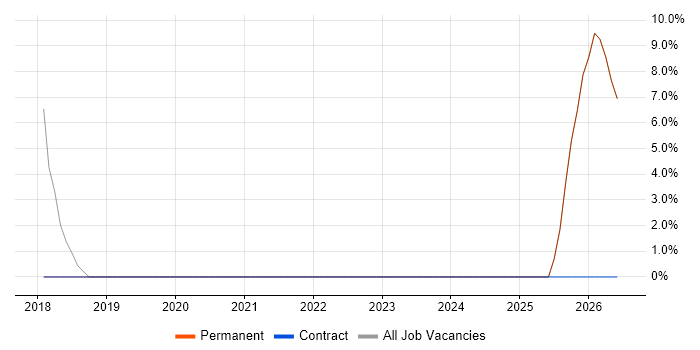
Historical trend showing the proportion of permanent IT job postings citing T-SQL relative to all permanent IT jobs advertised in Newton Abbot.
T-SQL
Co-Occurring Skills & Capabilities in Newton Abbot by Category
The following tables expand on the one above by listing co-occurrences grouped by category. They cover the same employment type, locality and period, with up to 20 co-occurrences shown in each category: