Development Operations Linux/Unix
UK > UK excluding London
The median Development Operations Linux/Unix daily rate in the UK excluding London is £419, according to job vacancies posted in the 6 months leading up to 13 December 2025.
The table below compares current contractor rates and summary statistics with the previous two years.
|
|
6 months to
13 Dec 2025 |
Same period 2024 |
Same period 2023 |
| Rank |
392 |
357 |
387 |
| Rank change year-on-year |
-35 |
+30 |
+116 |
| Contract jobs requiring a Linux/Unix DevOps |
7 |
3 |
25 |
| As % of all contract jobs in the UK excluding London |
0.039% |
0.019% |
0.12% |
| As % of the Job Titles category |
0.044% |
0.021% |
0.13% |
| Number of daily rates quoted |
6 |
1 |
16 |
| 10th Percentile |
£343 |
- |
- |
| 25th Percentile |
£381 |
- |
£513 |
| Median daily rate (50th Percentile) |
£419 |
£500 |
£590 |
| Median % change year-on-year |
-16.25% |
-15.25% |
-9.23% |
| 75th Percentile |
£506 |
- |
£681 |
| 90th Percentile |
£531 |
- |
£775 |
| UK median daily rate |
£450 |
£675 |
£540 |
| % change year-on-year |
-33.33% |
+25.00% |
-8.09% |
For comparison with the information above, the following table provides summary statistics for all contract IT job vacancies in the UK excluding London. Most job vacancies include a discernible job title that can be normalized. As such, the figures in the second row provide an indication of the number of contract jobs in our overall sample.
| Contract vacancies in the UK excluding London with a recognized job title |
16,071 |
14,630 |
18,984 |
| % of contract IT jobs with a recognized job title |
90.00% |
92.33% |
93.65% |
| Number of daily rates quoted |
9,915 |
8,581 |
12,451 |
| 10th Percentile |
£209 |
£213 |
£214 |
| 25th Percentile |
£363 |
£369 |
£381 |
| Median daily rate (50th Percentile) |
£475 |
£495 |
£500 |
| Median % change year-on-year |
-4.04% |
-1.00% |
- |
| 75th Percentile |
£575 |
£594 |
£600 |
| 90th Percentile |
£675 |
£675 |
£688 |
| UK median daily rate |
£500 |
£525 |
£525 |
| % change year-on-year |
-4.76% |
- |
-4.55% |
| Number of hourly rates quoted |
1,589 |
927 |
1,250 |
| 10th Percentile |
£13.80 |
£15.22 |
£14.36 |
| 25th Percentile |
£17.29 |
£20.12 |
£18.26 |
| Median hourly rate |
£25.15 |
£32.50 |
£44.50 |
| Median % change year-on-year |
-22.62% |
-26.97% |
+78.00% |
| 75th Percentile |
£56.69 |
£65.00 |
£65.00 |
| 90th Percentile |
£70.16 |
£72.50 |
£77.05 |
| UK median hourly rate |
£25.15 |
£34.75 |
£44.00 |
| % change year-on-year |
-27.63% |
-21.02% |
+40.98% |
Linux/Unix DevOps
Job Vacancy Trend in the UK excluding London
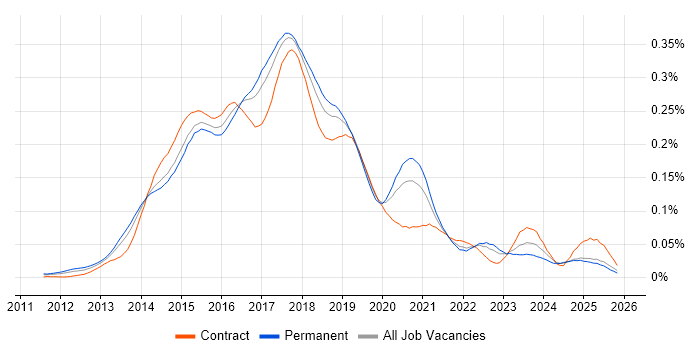
Historical trend showing the proportion of contract IT job postings featuring 'Linux/Unix DevOps' in the job title relative to all contract IT jobs advertised in the UK excluding London.
Linux/Unix DevOps
Daily Rate Trend in the UK excluding London
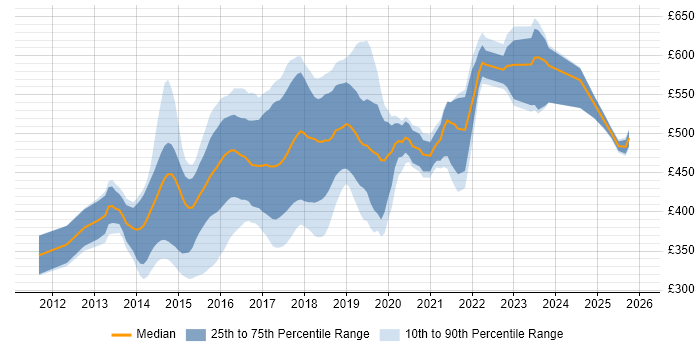
Contractor daily rate distribution trend for Linux/Unix DevOps job vacancies in the UK excluding London.
Linux/Unix DevOps
Daily Rate Histogram in the UK excluding London
Daily rate distribution for jobs citing Linux/Unix DevOps in the UK excluding London over the 6 months to 13 December 2025.
Linux/Unix DevOps
Contract Job Locations in the UK excluding London
The table below looks at the demand and provides a guide to the median contractor rates quoted in IT jobs citing Linux/Unix DevOps within the UK excluding London region over the 6 months to 13 December 2025. The 'Rank Change' column provides an indication of the change in demand within each location based on the same 6 month period last year.
Linux/Unix DevOps Skill Set
Top 30 Co-Occurring Skills & Capabilities in the UK excluding London
For the 6 months to 13 December 2025, Linux/Unix DevOps contract job roles required the following skills and capabilities in order of popularity.
The figures indicate the absolute number of co-occurrences and as a proportion of all contract job ads across the UK excluding London region featuring Linux/Unix DevOps in the job title.
Linux/Unix DevOps Skill Set
Co-Occurring Skills & Capabilities in the UK excluding London by Category
The following tables expand on the one above by listing co-occurrences grouped by category. They cover the same employment type, locality and period, with up to 20 co-occurrences shown in each category: