
Product Roadmap Job Trends in County Armagh
Product Roadmaps
Northern Ireland > County Armagh
The table below provides summary statistics and salary benchmarking for jobs advertised in County Armagh citing Product Roadmap skills. It covers permanent job vacancies from the 6 months leading up to 23 November 2026, with comparisons to the same periods in the previous two years.
| 6 months to 23 Nov 2026 |
Same period 2025 | Same period 2024 | |
|---|---|---|---|
| Rank | 37 | - | - |
| Rank change year-on-year | - | - | - |
| Permanent jobs citing Product Roadmap | 1 | 0 | 0 |
| As % of all permanent jobs in County Armagh | 0.53% | - | - |
| As % of the Processes & Methodologies category | 0.70% | - | - |
| Number of salaries quoted | 0 | 0 | 0 |
| Median annual salary (50th Percentile) | - | - | - |
| Northern Ireland median annual salary | - | £68,609 | £59,430 |
| % change year-on-year | - | +15.44% | - |
All Process & Methodology Skills
County Armagh
Product Roadmap falls under the Processes and Methodologies category. For comparison with the information above, the following table provides summary statistics for all permanent job vacancies citing process or methodology skills in County Armagh.
| 6 months to 23 Nov 2026 |
Same period 2025 | Same period 2024 | |
|---|---|---|---|
| Permanent vacancies citing process or methodology skills | 142 | 25 | 8 |
| As % of all permanent jobs advertised in County Armagh | 75.53% | 89.29% | 47.06% |
| Number of salaries quoted | 0 | 3 | 4 |
| 10th Percentile | - | - | - |
| 25th Percentile | - | - | £34,112 |
| Median annual salary (50th Percentile) | - | £30,000 | £36,149 |
| Median % change year-on-year | - | -17.01% | - |
| 75th Percentile | - | £55,000 | £38,694 |
| 90th Percentile | - | £70,000 | £39,610 |
| Northern Ireland median annual salary | £65,000 | £50,000 | £60,000 |
| % change year-on-year | +30.00% | -16.67% | +20.00% |
Product Roadmap Job Vacancy Trend in County Armagh
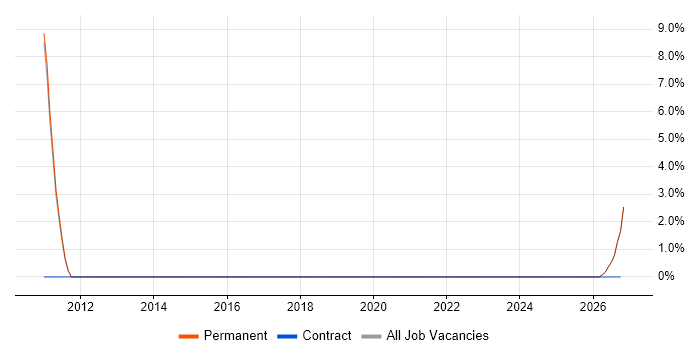
Historical trend showing the proportion of permanent IT job postings citing Product Roadmap relative to all permanent IT jobs advertised in County Armagh.
Product Roadmap Co-Occurring Skills & Capabilities in County Armagh by Category
The table below expands on the one above by listing co-occurrences one category at a time. It covers the same employment type, locality and period, with up to 20 co-occurrences in each category.
Processes & Methodologies
| Rank | Skill | Share | Job Ads |
|---|---|---|---|
| 1 | Architecture Governance | 100.0% | 1 |
| 1 | Business Strategy | 100.0% | 1 |
| 1 | Content Management | 100.0% | 1 |
| 1 | Continuous Improvement | 100.0% | 1 |
| 1 | Document Management | 100.0% | 1 |
| 1 | Enterprise Architecture | 100.0% | 1 |
| 1 | Enterprise Search | 100.0% | 1 |
| 1 | Information Security | 100.0% | 1 |
| 1 | Knowledge Management | 100.0% | 1 |
| 1 | Roadmaps | 100.0% | 1 |
| 1 | Stakeholder Management | 100.0% | 1 |
| 1 | Technology Roadmap | 100.0% | 1 |