
ITSM Job Trends in Yeovil
IT Service Management (ITSM)
Somerset > Yeovil
The table below provides summary statistics and salary benchmarking for jobs advertised in Yeovil citing ITSM skills. It covers permanent job vacancies from the 6 months leading up to 24 November 2026, with comparisons to the same periods in the previous two years.
| 6 months to 24 Nov 2026 |
Same period 2025 | Same period 2024 | |
|---|---|---|---|
| Rank | 8 | - | - |
| Rank change year-on-year | - | - | - |
| Permanent jobs citing ITSM | 8 | 0 | 0 |
| As % of all permanent jobs in Yeovil | 6.45% | - | - |
| As % of the Processes & Methodologies category | 8.08% | - | - |
| Number of salaries quoted | 3 | 0 | 0 |
| Median annual salary (50th Percentile) | £60,000 | - | - |
| Somerset median annual salary | £60,000 | £46,596 | £90,000 |
| % change year-on-year | +28.77% | -48.23% | +233.33% |
All Process & Methodology Skills
Yeovil
ITSM falls under the Processes and Methodologies category. For comparison with the information above, the following table provides summary statistics for all permanent job vacancies citing process or methodology skills in Yeovil.
| 6 months to 24 Nov 2026 |
Same period 2025 | Same period 2024 | |
|---|---|---|---|
| Permanent vacancies citing process or methodology skills | 99 | 11 | 17 |
| As % of all permanent jobs advertised in Yeovil | 79.84% | 32.35% | 40.48% |
| Number of salaries quoted | 39 | 6 | 9 |
| 10th Percentile | £52,250 | £31,025 | £57,800 |
| 25th Percentile | - | £37,695 | - |
| Median annual salary (50th Percentile) | £60,000 | £55,000 | £60,000 |
| Median % change year-on-year | +9.09% | -8.33% | +112.09% |
| 75th Percentile | £70,000 | £57,500 | - |
| 90th Percentile | £78,000 | £71,600 | £70,000 |
| Somerset median annual salary | £50,000 | £40,000 | £52,000 |
| % change year-on-year | +25.00% | -23.08% | +12.08% |
ITSM Job Vacancy Trend in Yeovil
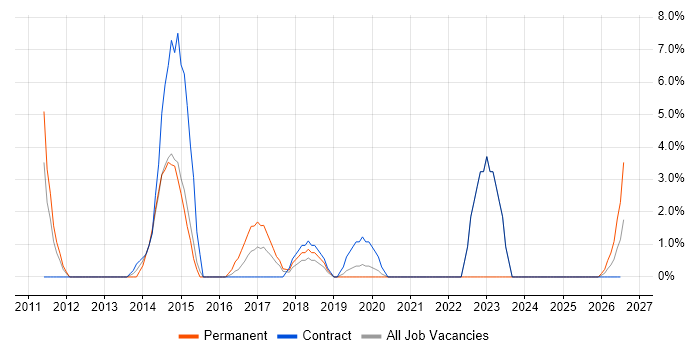
Historical trend showing the proportion of permanent IT job postings citing ITSM relative to all permanent IT jobs advertised in Yeovil.
ITSM Salary Trend in Yeovil
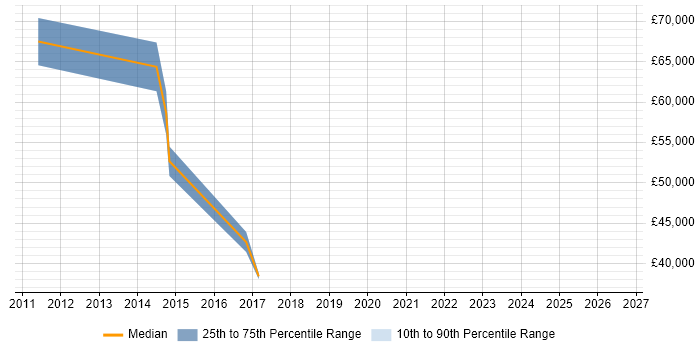
Salary distribution trend for jobs in Yeovil citing ITSM.
ITSM Co-Occurring Skills & Capabilities in Yeovil by Category
The table below expands on the one above by listing co-occurrences one category at a time. It covers the same employment type, locality and period, with up to 20 co-occurrences in each category.
Processes & Methodologies
| Rank | Skill | Share | Job Ads |
|---|---|---|---|
| 1 | Agile | 12.5% | 1 |
| 1 | Analytics | 12.5% | 1 |
| 1 | API Integration | 12.5% | 1 |
| 1 | Application Security | 12.5% | 1 |
| 1 | CI/CD | 12.5% | 1 |
| 1 | Collaborative Working | 12.5% | 1 |
| 1 | Continuous Improvement | 12.5% | 1 |
| 1 | Cybersecurity | 12.5% | 1 |
| 1 | DevOps | 12.5% | 1 |
| 1 | Identity Management | 12.5% | 1 |
| 1 | Incident Response | 12.5% | 1 |
| 1 | Integration Patterns | 12.5% | 1 |
| 1 | ITIL | 12.5% | 1 |
| 1 | Problem-Solving | 12.5% | 1 |
| 1 | RBAC | 12.5% | 1 |
| 1 | Service Management | 12.5% | 1 |
| 1 | Service-Level Objective | 12.5% | 1 |
| 1 | SIEM | 12.5% | 1 |
| 1 | SOAR | 12.5% | 1 |
| 1 | Systems Engineering | 12.5% | 1 |