
Cloud Architect Job Trends in Yorkshire
Cloud Architect
England > Yorkshire
The median Cloud Architect salary in Yorkshire is £70,000 per year, according to job vacancies posted during the 6 months leading to 22 November 2026.
The table below compares current salary benchmarking and summary statistics with the previous two years.
| 6 months to 22 Nov 2026 |
Same period 2025 | Same period 2024 | |
|---|---|---|---|
| Rank | 180 | 150 | 154 |
| Rank change year-on-year | -30 | +4 | +18 |
| Permanent Cloud Architect jobs | 11 | 5 | 13 |
| As % of all permanent jobs in Yorkshire | 0.15% | 0.14% | 0.31% |
| As % of the Job Titles category | 0.16% | 0.17% | 0.33% |
| Number of salaries quoted | 11 | 2 | 10 |
| 10th Percentile | - | £82,000 | £69,325 |
| 25th Percentile | - | £85,000 | - |
| Median annual salary (50th Percentile) | £70,000 | £90,000 | £70,000 |
| Median % change year-on-year | -22.22% | +28.57% | -12.10% |
| 75th Percentile | - | £95,000 | - |
| 90th Percentile | £82,500 | £98,000 | £97,750 |
| England median annual salary | £95,000 | £90,000 | £85,000 |
| % change year-on-year | +5.56% | +5.88% | -10.53% |
All Permanent IT Job Roles
Yorkshire
For comparison with the information above, the following table provides summary statistics for all permanent IT job adverts in Yorkshire matching a recognised job title. The table also shows what proportion of all permanent IT job adverts they make up.
| 6 months to 22 Nov 2026 |
Same period 2025 | Same period 2024 | |
|---|---|---|---|
| Permanent job adverts in Yorkshire matching a recognised job title | 6,708 | 3,025 | 3,997 |
| % of permanent job adverts matching a recognised job title | 90.98% | 87.50% | 94.92% |
| Number of salaries quoted | 4,758 | 1,784 | 1,933 |
| 10th Percentile | £30,000 | £26,250 | £29,000 |
| 25th Percentile | £40,000 | £30,250 | £40,000 |
| Median annual salary (50th Percentile) | £55,000 | £45,000 | £50,000 |
| Median % change year-on-year | +22.22% | -10.00% | -4.31% |
| 75th Percentile | £70,000 | £67,500 | £67,500 |
| 90th Percentile | £85,000 | £80,000 | £81,250 |
| England median annual salary | £60,000 | £54,500 | £57,500 |
| % change year-on-year | +10.09% | -5.22% | -4.17% |
Cloud Architect Job Vacancy Trend in Yorkshire
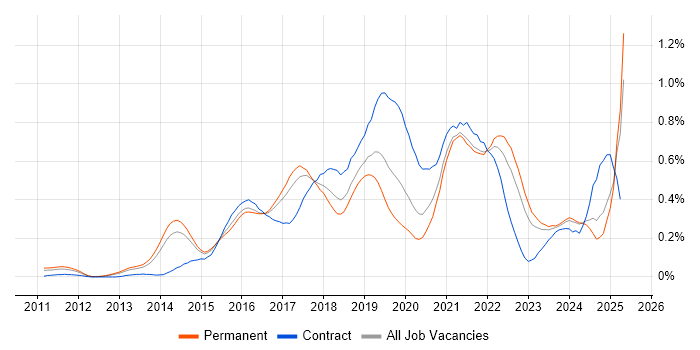
Historical trend showing the proportion of permanent Cloud Architect job postings relative to all permanent IT jobs advertised in Yorkshire.
Cloud Architect Salary Trend in Yorkshire
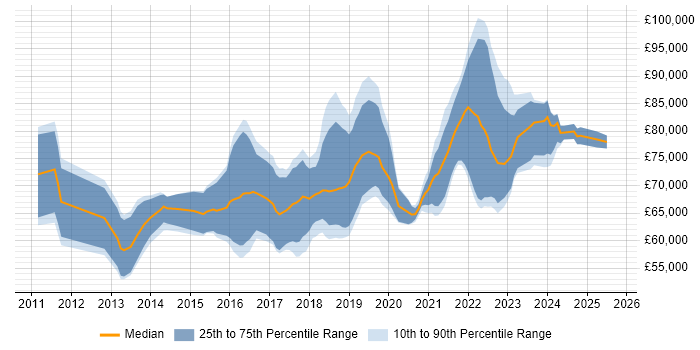
Salary distribution trend for Cloud Architect job vacancies in Yorkshire.
Cloud Architect Salary Histogram in Yorkshire
Salary distribution for Cloud Architect jobs in Yorkshire over the 6 months to 22 November 2026.
Cloud Architect Job Locations in Yorkshire
The table below looks at the demand and provides a guide to the median salaries quoted in Cloud Architect jobs within the Yorkshire region over the 6 months to 22 November 2026. The 'Rank Change' column provides an indication of the change in demand within each location based on the same 6 month period last year.
| Location | Rank Change on Same Period Last Year |
Job Ads Past 6 Months |
Median Salary Past 6 Months |
Median Salary % Change on Same Period Last Year |
Live Jobs |
|---|---|---|---|---|---|
| West Yorkshire | -19 | 11 | £70,000 | -22.22% | 15 |
| Cloud Architect England |
|||||
Cloud Architect Skill Set Top 30 Co-Occurring Skills & Capabilities in Yorkshire
For the 6 months to 22 November 2026, Cloud Architect job ads cited the following skills and capabilities in order of popularity. The figures indicate the absolute number of co-occurrences and as a proportion of all permanent Cloud Architect job ads across the Yorkshire region.
| Rank | Skill | Share | Job Ads |
|---|---|---|---|
| 1 | GCP | 18.2% | 2 |
| 1 | Terraform | 18.2% | 2 |
| 3 | Avaya | 9.1% | 1 |
| 3 | AWS | 9.1% | 1 |
| 3 | Azure | 9.1% | 1 |
| 3 | CI/CD | 9.1% | 1 |
| 3 | Cisco | 9.1% | 1 |
| 3 | Cloud Security | 9.1% | 1 |
| 3 | Customer Requirements | 9.1% | 1 |
| 3 | Cybersecurity | 9.1% | 1 |
| 3 | DevOps | 9.1% | 1 |
| 3 | Enterprise Architecture | 9.1% | 1 |
| 3 | Firewall | 9.1% | 1 |
| 3 | Genesys | 9.1% | 1 |
| 3 | GitHub | 9.1% | 1 |
| 3 | 9.1% | 1 | |
| 3 | IT Strategy | 9.1% | 1 |
| 3 | ITIL | 9.1% | 1 |
| 3 | LAN | 9.1% | 1 |
| 3 | Microsoft | 9.1% | 1 |
| 3 | Model-Based Systems Engineering | 9.1% | 1 |
| 3 | Network Segmentation | 9.1% | 1 |
| 3 | Observability | 9.1% | 1 |
| 3 | Palo Alto | 9.1% | 1 |
| 3 | Python | 9.1% | 1 |
| 3 | Roadmaps | 9.1% | 1 |
| 3 | SaaS | 9.1% | 1 |
| 3 | SD-WAN | 9.1% | 1 |
| 3 | Software Engineering | 9.1% | 1 |
| 3 | Technical Leadership | 9.1% | 1 |
Cloud Architect Skill Set Co-Occurring Skills & Capabilities in Yorkshire by Category
The table below expands on the one above by listing co-occurrences one category at a time. It covers the same employment type, locality and period, with up to 20 co-occurrences in each category.
Job Titles
| Rank | Job Title | Share | Job Ads |
|---|---|---|---|
| 1 | Cloud Infrastructure Architect | 72.7% | 8 |
| 1 | Cloud Solutions Architect | 72.7% | 8 |
| 1 | Infrastructure Solutions Architect | 72.7% | 8 |
| 4 | Cloud Native Architect | 9.1% | 1 |
| 4 | Network Security Architect | 9.1% | 1 |
| 4 | Principal Security Architect | 9.1% | 1 |