
C# Software Developer Job Trends in Yorkshire
C# Software Developer
England > Yorkshire
The median C# Software Developer salary in Yorkshire is £85,000 per year, according to job vacancies posted during the 6 months leading to 14 November 2026.
The table below compares current salary benchmarking and summary statistics with the previous two years.
| 6 months to 14 Nov 2026 |
Same period 2025 | Same period 2024 | |
|---|---|---|---|
| Rank | 192 | 161 | 127 |
| Rank change year-on-year | -31 | -34 | +55 |
| Permanent C# Software Developer jobs | 5 | 2 | 43 |
| As % of all permanent jobs in Yorkshire | 0.067% | 0.055% | 1.02% |
| As % of the Job Titles category | 0.074% | 0.063% | 1.08% |
| Number of salaries quoted | 5 | 2 | 43 |
| 10th Percentile | - | £84,125 | £30,000 |
| 25th Percentile | £47,500 | £84,688 | £36,875 |
| Median annual salary (50th Percentile) | £85,000 | £88,750 | £49,500 |
| Median % change year-on-year | -4.23% | +79.29% | +5.88% |
| 75th Percentile | - | £92,188 | £50,750 |
| 90th Percentile | - | £92,375 | £60,000 |
| England median annual salary | £52,500 | £51,000 | £50,000 |
| % change year-on-year | +2.94% | +2.00% | -9.09% |
All Permanent IT Job Roles
Yorkshire
For comparison with the information above, the following table provides summary statistics for all permanent IT job adverts in Yorkshire matching a recognised job title. The table also shows what proportion of all permanent IT job adverts they make up.
| 6 months to 14 Nov 2026 |
Same period 2025 | Same period 2024 | |
|---|---|---|---|
| Permanent job adverts in Yorkshire matching a recognised job title | 6,801 | 3,154 | 3,992 |
| % of permanent job adverts matching a recognised job title | 91.23% | 86.77% | 95.02% |
| Number of salaries quoted | 4,843 | 1,785 | 1,915 |
| 10th Percentile | £30,000 | £26,250 | £28,600 |
| 25th Percentile | £40,000 | £30,250 | £40,000 |
| Median annual salary (50th Percentile) | £55,000 | £45,000 | £50,000 |
| Median % change year-on-year | +22.22% | -10.00% | -3.67% |
| 75th Percentile | £70,000 | £65,000 | £66,250 |
| 90th Percentile | £83,750 | £80,000 | £80,000 |
| England median annual salary | £60,000 | £53,056 | £57,500 |
| % change year-on-year | +13.09% | -7.73% | -4.17% |
C# Software Developer Job Vacancy Trend in Yorkshire
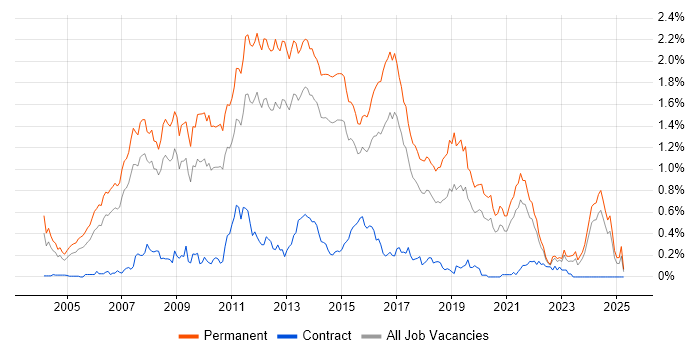
Historical trend showing the proportion of permanent C# Software Developer job postings relative to all permanent IT jobs advertised in Yorkshire.
C# Software Developer Salary Trend in Yorkshire
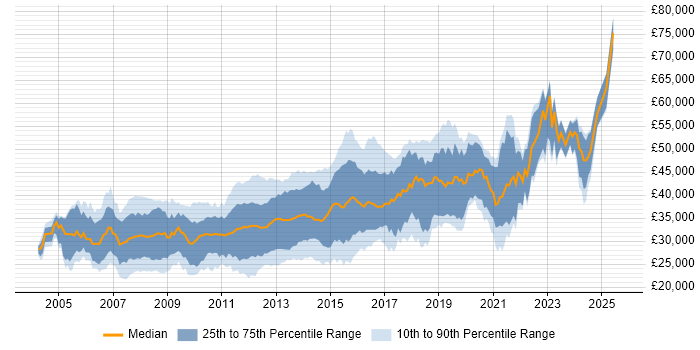
Salary distribution trend for C# Software Developer job vacancies in Yorkshire.
C# Software Developer Salary Histogram in Yorkshire
Salary distribution for C# Software Developer jobs in Yorkshire over the 6 months to 14 November 2026.
C# Software Developer Job Locations in Yorkshire
The table below looks at the demand and provides a guide to the median salaries quoted in C# Software Developer jobs within the Yorkshire region over the 6 months to 14 November 2026. The 'Rank Change' column provides an indication of the change in demand within each location based on the same 6 month period last year.
| Location | Rank Change on Same Period Last Year |
Job Ads Past 6 Months |
Median Salary Past 6 Months |
Median Salary % Change on Same Period Last Year |
Live Jobs |
|---|---|---|---|---|---|
| South Yorkshire | -25 | 3 | £85,000 | -5.56% | |
| West Yorkshire | -23 | 2 | £50,000 | -42.86% | |
| C# Software Developer England |
|||||
C# Software Developer Skill Set Top 17 Co-Occurring Skills & Capabilities in Yorkshire
For the 6 months to 14 November 2026, C# Software Developer job ads cited the following skills and capabilities in order of popularity. The figures indicate the absolute number of co-occurrences and as a proportion of all permanent C# Software Developer job ads across the Yorkshire region.
| Rank | Skill | Share | Job Ads |
|---|---|---|---|
| 1 | .NET | 100.0% | 5 |
| 1 | C# | 100.0% | 5 |
| 3 | Azure | 60.0% | 3 |
| 3 | Technical Leadership | 60.0% | 3 |
| 5 | AWS | 40.0% | 2 |
| 5 | Continuous Improvement | 40.0% | 2 |
| 5 | CQRS | 40.0% | 2 |
| 5 | CSS | 40.0% | 2 |
| 5 | Full-Stack Development | 40.0% | 2 |
| 5 | HTML | 40.0% | 2 |
| 5 | Microservices | 40.0% | 2 |
| 5 | Product Vision | 40.0% | 2 |
| 5 | Resource Allocation | 40.0% | 2 |
| 5 | SaaS | 40.0% | 2 |
| 5 | SDLC | 40.0% | 2 |
| 5 | Software Engineering | 40.0% | 2 |
| 5 | Vue | 40.0% | 2 |
C# Software Developer Skill Set Co-Occurring Skills & Capabilities in Yorkshire by Category
The table below expands on the one above by listing co-occurrences one category at a time. It covers the same employment type, locality and period, with up to 20 co-occurrences in each category.
Job Titles
| Rank | Job Title | Share | Job Ads |
|---|---|---|---|
| 1 | Lead C# Developer | 60.0% | 3 |
| 1 | Lead Software Developer | 60.0% | 3 |
| 3 | .NET Software Developer | 40.0% | 2 |
| 3 | .NET Software Engineer | 40.0% | 2 |
| 3 | C# .NET Developer | 40.0% | 2 |
| 3 | C# Software Engineer | 40.0% | 2 |
| 3 | Developer/Software Engineer | 40.0% | 2 |
| 3 | Full-Stack .NET Developer | 40.0% | 2 |
| 3 | Full-Stack C# Developer | 40.0% | 2 |
| 3 | Full-Stack Software Engineer | 40.0% | 2 |