
Oracle Procure-to-Pay Contract Job Trends in England
Oracle Procure-to-Pay (Oracle P2P)
UK > England
The table below provides summary statistics and contractor rates for jobs advertised in England citing Oracle Procure-to-Pay skills. It covers contract job vacancies from the 6 months leading up to 28 October 2026, with comparisons to the same periods in the previous two years.
| 6 months to 28 Oct 2026 |
Same period 2025 | Same period 2024 | |
|---|---|---|---|
| Rank | 610 | 482 | 460 |
| Rank change year-on-year | -128 | -22 | +89 |
| Contract jobs citing Oracle Procure-to-Pay | 45 | 34 | 48 |
| As % of all contract jobs in England | 0.097% | 0.12% | 0.15% |
| As % of the Business Applications category | 1.39% | 1.37% | 2.19% |
| Number of daily rates quoted | 34 | 26 | 22 |
| 10th Percentile | - | £445 | £450 |
| 25th Percentile | £513 | £543 | £469 |
| Median daily rate (50th Percentile) | £575 | £625 | £525 |
| Median % change year-on-year | -8.00% | +19.05% | -2.33% |
| 75th Percentile | £741 | £650 | £699 |
| 90th Percentile | £789 | £688 | £799 |
| UK median daily rate | £550 | £625 | £525 |
| % change year-on-year | -12.00% | +19.05% | -2.33% |
| Number of hourly rates quoted | 0 | 0 | 1 |
| Median hourly rate | - | - | £23.60 |
| UK median hourly rate | - | - | £23.60 |
| % change year-on-year | - | - | -73.33% |
All Business Application Skills
England
Oracle Procure-to-Pay falls under the Business Applications category. For comparison with the information above, the following table provides summary statistics for all contract job vacancies citing business application skills in England.
| 6 months to 28 Oct 2026 |
Same period 2025 | Same period 2024 | |
|---|---|---|---|
| Contract vacancies citing business application skills | 3,233 | 2,475 | 2,193 |
| As % of all contract jobs advertised in England | 6.97% | 8.60% | 7.04% |
| Number of daily rates quoted | 1,792 | 1,483 | 1,212 |
| 10th Percentile | £388 | £358 | £375 |
| 25th Percentile | £469 | £450 | £463 |
| Median daily rate (50th Percentile) | £550 | £550 | £550 |
| 75th Percentile | £671 | £673 | £675 |
| 90th Percentile | £775 | £750 | £775 |
| UK median daily rate | £550 | £550 | £550 |
| Number of hourly rates quoted | 171 | 42 | 65 |
| 10th Percentile | £15.00 | £12.82 | £27.24 |
| 25th Percentile | £19.48 | £21.60 | £35.00 |
| Median hourly rate | £34.87 | £41.43 | £40.33 |
| Median % change year-on-year | -15.83% | +2.73% | -28.62% |
| 75th Percentile | £62.50 | £72.50 | £61.60 |
| 90th Percentile | £87.50 | £93.38 | £77.25 |
| UK median hourly rate | £36.19 | £34.48 | £40.33 |
| % change year-on-year | +4.94% | -14.49% | -28.62% |
Oracle Procure-to-Pay Job Vacancy Trend in England
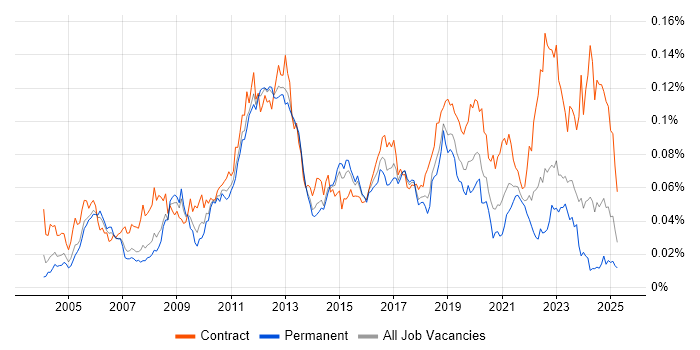
Historical trend showing the proportion of contract IT job postings citing Oracle Procure-to-Pay relative to all contract IT jobs advertised in England.
Oracle Procure-to-Pay Daily Rate Trend in England
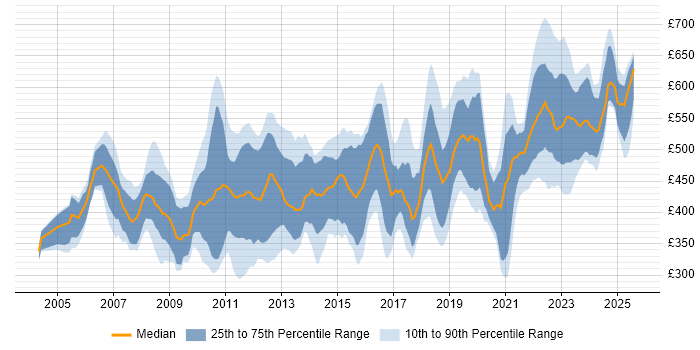
Contractor daily rate distribution trend for jobs in England citing Oracle Procure-to-Pay.
Oracle Procure-to-Pay Daily Rate Histogram in England
Daily rate distribution for jobs citing Oracle Procure-to-Pay in England over the 6 months to 28 October 2026.
Oracle Procure-to-Pay Hourly Rate Trend in England
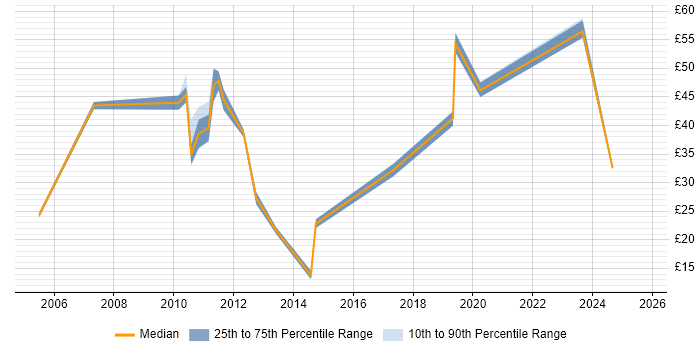
Contractor hourly rate distribution trend for jobs in England citing Oracle Procure-to-Pay.
Oracle Procure-to-Pay Contract Job Locations in England
The table below looks at the demand and provides a guide to the median contractor rates quoted in IT jobs citing Oracle Procure-to-Pay within the England region over the 6 months to 28 October 2026. The 'Rank Change' column provides an indication of the change in demand within each location based on the same 6 month period last year.
| Location | Rank Change on Same Period Last Year |
Job Ads Past 6 Months |
Median Daily Rate Past 6 Months |
Median Daily Rate % Change on Same Period Last Year |
Live Jobs |
|---|---|---|---|---|---|
| London | -78 | 25 | £700 | +7.69% | 3 |
| Midlands | -30 | 14 | £525 | -12.50% | |
| West Midlands | -28 | 11 | £525 | +16.67% | |
| East Midlands | -14 | 3 | £550 | -12.00% | |
| North of England | -67 | 2 | £625 | - | |
| North East | - | 2 | £625 | - | |
| East of England | -18 | 1 | - | - | |
| South East | -66 | 1 | - | - | |
| Oracle Procure-to-Pay UK |
|||||
Oracle Procure-to-Pay Co-Occurring Skills & Capabilities in England by Category
The table below expands on the one above by listing co-occurrences one category at a time. It covers the same employment type, locality and period, with up to 20 co-occurrences in each category.
Business Applications
| Rank | Skill | Share | Job Ads |
|---|---|---|---|
| 1 | Oracle Payables | 66.7% | 30 |
| 2 | Oracle General Ledger | 44.4% | 20 |
| 3 | Oracle ERP | 35.6% | 16 |
| 4 | Oracle Receivables | 33.3% | 15 |
| 5 | Oracle Assets | 26.7% | 12 |
| 6 | Oracle Financials | 20.0% | 9 |
| 7 | Oracle Cash Management | 11.1% | 5 |
| 8 | Oracle EBS | 8.9% | 4 |
| 9 | Oracle SCM | 6.7% | 3 |
| 10 | NetSuite | 4.4% | 2 |
| 11 | Dynamics CRM | 2.2% | 1 |
| 11 | Oracle Applications | 2.2% | 1 |
| 11 | Oracle EBS R12 | 2.2% | 1 |
| 11 | Oracle iProcurement | 2.2% | 1 |
| 11 | Oracle Subledger Accounting | 2.2% | 1 |
| 11 | Unit4 Business World | 2.2% | 1 |