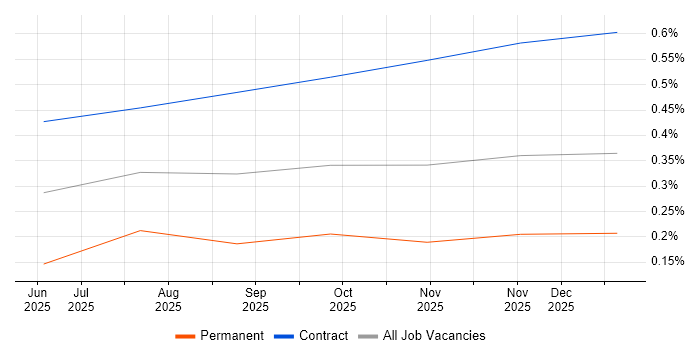
Model Context Protocol Job Trends in the City of London

Model Context Protocol (MCP)
Central London > City of London

The table below provides summary statistics and salary benchmarking for jobs advertised in the City of London requiring Model Context Protocol skills. It covers permanent job vacancies from the 6 months leading up to 30 January 2026, with comparisons to the same periods in the previous two years.

6 months to
30 Jan 2026
Same period 2025 Same period 2024
Rank 137 - -
Rank change year-on-year - - -
Permanent jobs citing Model Context Protocol 5 0 0
As % of all permanent jobs in the City of London 0.20% - -
As % of the Libraries, Frameworks & Software Standards category 1.09% - -
Number of salaries quoted 3 0 0
10th Percentile £62,750 - -
25th Percentile £63,125 - -
Median annual salary (50th Percentile) £67,500 - -
75th Percentile £83,750 - -
90th Percentile £91,250 - -
Central London median annual salary £67,500 - -

All Software Libraries and Frameworks
City of London

Model Context Protocol falls under the Software Libraries and Frameworks category. For comparison with the information above, the following table provides summary statistics for all permanent job vacancies requiring technical specification, industry standards, software libraries and framework skills in the City of London.

Permanent vacancies with a requirement for technical specification, industry standards, software libraries and framework skills 459 769 894
As % of all permanent jobs advertised in the City of London 18.06% 29.74% 28.99%
Number of salaries quoted 390 565 834
10th Percentile £57,500 £52,500 £50,000
25th Percentile £70,000 £56,250 £61,250
Median annual salary (50th Percentile) £85,500 £75,000 £80,000
Median % change year-on-year +14.00% -6.25% -
75th Percentile £105,000 £97,500 £104,375
90th Percentile £125,000 £115,000 £115,000
Central London median annual salary £87,500 £75,000 £80,000
% change year-on-year +16.67% -6.25% -

Model Context Protocol
Job Vacancy Trend in the City of London

Historical trend showing the proportion of permanent IT job postings citing Model Context Protocol relative to all permanent IT jobs advertised in the City of London.

Model Context Protocol job vacancy trend in the City of London

Model Context Protocol
Salary Histogram in the City of London

Salary distribution for jobs citing Model Context Protocol in the City of London over the 6 months to 30 January 2026.

Salary histogram for Model Context Protocol in the City of London

Model Context Protocol
Co-Occurring Skills & Capabilities in the City of London by Category

The following tables expand on the one above by listing co-occurrences grouped by category. They cover the same employment type, locality and period, with up to 20 co-occurrences shown in each category:

Cloud Services
1 4 (80.00%) Azure
2 3 (60.00%) Power Platform
3 2 (40.00%) Azure DevOps
3 2 (40.00%) Figma
3 2 (40.00%) Lucidchart
3 2 (40.00%) Microsoft 365
3 2 (40.00%) PaaS
3 2 (40.00%) SaaS
4 1 (20.00%) Azure AI
4 1 (20.00%) n8n
Database & Business Intelligence
1 1 (20.00%) NoSQL
Development Applications
1 2 (40.00%) Balsamiq
2 1 (20.00%) MLflow
General
1 2 (40.00%) Finance
1 2 (40.00%) Presentation Skills
1 2 (40.00%) Social Skills
2 1 (20.00%) Legal
Job Titles
1 2 (40.00%) Architect
1 2 (40.00%) IT Architect
1 2 (40.00%) Solutions Architect
2 1 (20.00%) Artificial Intelligence Engineer
2 1 (20.00%) Developer
2 1 (20.00%) Machine Learning Engineer
2 1 (20.00%) Python Developer
2 1 (20.00%) Senior
Libraries, Frameworks & Software Standards
1 2 (40.00%) PyTorch
1 2 (40.00%) React
2 1 (20.00%) Hugging Face
2 1 (20.00%) LangChain
2 1 (20.00%) Node.js
2 1 (20.00%) RESTful
2 1 (20.00%) TensorFlow
Miscellaneous
1 3 (60.00%) AI Agents
2 2 (40.00%) Public Cloud
3 1 (20.00%) Low-Code
Processes & Methodologies
1 5 (100.00%) AI
1 5 (100.00%) Machine Learning
2 4 (80.00%) LLM
3 2 (40.00%) Agile
3 2 (40.00%) Architectural Design
3 2 (40.00%) Coaching
3 2 (40.00%) Creative Thinking
3 2 (40.00%) Design Patterns
3 2 (40.00%) DevOps
3 2 (40.00%) Infrastructure as Code
3 2 (40.00%) Mentoring
3 2 (40.00%) Minimum Viable Product
3 2 (40.00%) Natural Language Processing
3 2 (40.00%) TOGAF
3 2 (40.00%) UML
3 2 (40.00%) User Experience
3 2 (40.00%) UX Design
4 1 (20.00%) Analytics
4 1 (20.00%) Continuous Improvement
4 1 (20.00%) Deep Learning
Programming Languages
1 5 (100.00%) Python
2 4 (80.00%) SQL
3 2 (40.00%) C#
3 2 (40.00%) JavaScript
4 1 (20.00%) TypeScript
Qualifications
1 3 (60.00%) Microsoft Certified Professional
System Software
1 1 (20.00%) Docker
Vendors
1 3 (60.00%) Microsoft
2 1 (20.00%) Google
2 1 (20.00%) OpenAI