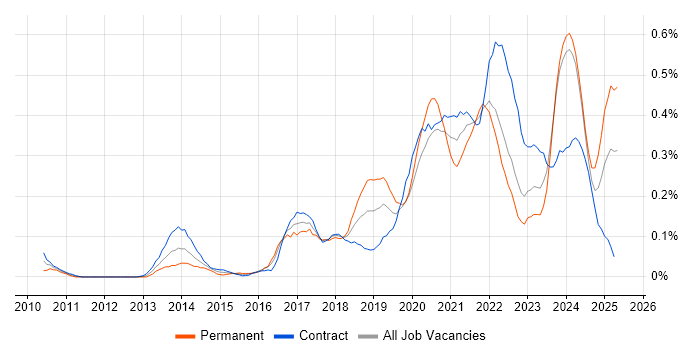
SAML Job Trends in Scotland

Security Assertion Markup Language (SAML)
UK > Scotland

The table below provides summary statistics and salary benchmarking for jobs advertised in Scotland requiring SAML skills. It covers permanent job vacancies from the 6 months leading up to 14 March 2026, with comparisons to the same periods in the previous two years.

6 months to
14 Mar 2026
Same period 2025 Same period 2024
Rank 96 122 187
Rank change year-on-year +26 +65 +31
Permanent jobs citing SAML 46 12 56
As % of all permanent jobs in Scotland 1.51% 0.57% 1.12%
As % of the Libraries, Frameworks & Software Standards category 12.43% 2.59% 3.44%
Number of salaries quoted 0 11 3
10th Percentile - £64,472 £82,750
25th Percentile - £90,801 £83,125
Median annual salary (50th Percentile) - £94,637 £87,500
Median % change year-on-year - +8.16% +59.09%
75th Percentile - £98,474 £90,625
90th Percentile - - £91,000
UK median annual salary £75,000 £75,000 £66,560
% change year-on-year - +12.68% +10.93%

All Software Libraries and Frameworks
Scotland

SAML falls under the Software Libraries and Frameworks category. For comparison with the information above, the following table provides summary statistics for all permanent job vacancies requiring technical specification, industry standards, software libraries and framework skills in Scotland.

Permanent vacancies with a requirement for technical specification, industry standards, software libraries and framework skills 370 463 1,630
As % of all permanent jobs advertised in Scotland 12.11% 22.06% 32.63%
Number of salaries quoted 155 323 599
10th Percentile £28,250 £31,250 £38,500
25th Percentile £33,750 £41,250 £46,250
Median annual salary (50th Percentile) £60,000 £57,500 £60,000
Median % change year-on-year +4.35% -4.17% -
75th Percentile £70,000 £77,500 £72,433
90th Percentile £80,000 £98,474 £82,500
UK median annual salary £65,000 £66,200 £60,000
% change year-on-year -1.81% +10.33% -11.11%

SAML
Job Vacancy Trend in Scotland

Historical trend showing the proportion of permanent IT job postings citing SAML relative to all permanent IT jobs advertised in Scotland.

SAML job vacancy trend in Scotland

SAML
Salary Trend in Scotland

Salary distribution trend for jobs in Scotland citing SAML.

Salary distribution trend for jobs in Scotland citing SAML

SAML
Job Locations in Scotland

The table below looks at the demand and provides a guide to the median salaries quoted in IT jobs citing SAML within the Scotland region over the 6 months to 14 March 2026. The 'Rank Change' column provides an indication of the change in demand within each location based on the same 6 month period last year.

Location Rank Change
on Same Period
Last Year
Matching
Permanent
IT Job Ads
Median Salary
Past 6 Months
Median Salary
% Change
on Same Period
Last Year
Live
Jobs
Edinburgh 0 16 - -
Stirling - 11 - -
Midlothian - 6 - -
West Lothian - 5 - -
Fife - 4 - -
Falkirk - 2 - -
Lanarkshire - 1 - -
East Lothian - 1 - -
Clackmannanshire - 1 - -
SAML
UK

SAML
Co-Occurring Skills & Capabilities in Scotland by Category

The following tables expand on the one above by listing co-occurrences grouped by category. They cover the same employment type, locality and period, with up to 20 co-occurrences shown in each category:

Application Platforms
1 11 (23.91%) Oracle SOA Suite
Business Applications
1 11 (23.91%) Oracle ERP
2 3 (6.52%) Workday HCM
Cloud Services
1 46 (100.00%) Azure
2 32 (69.57%) Entra ID
2 32 (69.57%) Google Workspace
3 11 (23.91%) Azure DevOps
3 11 (23.91%) GitHub
3 11 (23.91%) GitHub Copilot
3 11 (23.91%) OCI
3 11 (23.91%) Power Platform
4 3 (6.52%) Azure Logic Apps
4 3 (6.52%) Boomi
4 3 (6.52%) SaaS
Communications & Networking
1 32 (69.57%) Broadband
Database & Business Intelligence
1 11 (23.91%) Power BI
1 11 (23.91%) Tableau
Development Applications
1 14 (30.43%) JIRA
2 11 (23.91%) Git
2 11 (23.91%) Jenkins
2 11 (23.91%) Oracle Forms
General
1 32 (69.57%) Games
1 32 (69.57%) Organisational Skills
1 32 (69.57%) Social Skills
2 14 (30.43%) Finance
Job Titles
1 20 (43.48%) Senior
2 13 (28.26%) Developer
2 13 (28.26%) IAM Developer
3 11 (23.91%) Applications Engineer
3 11 (23.91%) Cloud Engineer
4 9 (19.57%) Senior Developer
5 8 (17.39%) Systems Engineer
6 4 (8.70%) Architect
6 4 (8.70%) Senior Architect
6 4 (8.70%) Senior Systems Engineer
6 4 (8.70%) Systems Developer
Libraries, Frameworks & Software Standards
1 43 (93.48%) OAuth
2 35 (76.09%) REST
2 35 (76.09%) SOAP
3 32 (69.57%) GraphQL
3 32 (69.57%) LDAP
3 32 (69.57%) OpenID
4 11 (23.91%) OAuth2
4 11 (23.91%) RESTful
5 3 (6.52%) Web Services
Miscellaneous
1 32 (69.57%) Cyber Threat
1 32 (69.57%) Cyberattack
2 11 (23.91%) Cloud Native
2 11 (23.91%) Enterprise Software
3 3 (6.52%) Product Ownership
Processes & Methodologies
1 35 (76.09%) Mentoring
1 35 (76.09%) Roadmaps
2 32 (69.57%) Cybersecurity
2 32 (69.57%) Identity Access Management
2 32 (69.57%) Programme Delivery
2 32 (69.57%) Regulatory Compliance
3 14 (30.43%) Agile
3 14 (30.43%) Asset Management
3 14 (30.43%) Coaching
4 11 (23.91%) AI
4 11 (23.91%) Analytics
4 11 (23.91%) API Integration
4 11 (23.91%) Business Intelligence
4 11 (23.91%) DevOps
4 11 (23.91%) ERP
4 11 (23.91%) Event-Driven
4 11 (23.91%) Event-Driven Architecture
4 11 (23.91%) Microservices
4 11 (23.91%) SOA
4 11 (23.91%) Test Automation
Programming Languages
1 35 (76.09%) PowerShell
2 32 (69.57%) Bash
2 32 (69.57%) T-SQL
3 14 (30.43%) Python
4 11 (23.91%) Java
4 11 (23.91%) PL/SQL
4 11 (23.91%) Shell Script
4 11 (23.91%) SQL
5 3 (6.52%) JavaScript
Quality Assurance & Compliance
1 32 (69.57%) NCSC
1 32 (69.57%) NIST
2 3 (6.52%) GDPR
System Software
1 32 (69.57%) Active Directory
Systems Management
1 14 (30.43%) Single Sign-On
2 11 (23.91%) Terraform
Vendors
1 11 (23.91%) Microsoft
1 11 (23.91%) Oracle
2 3 (6.52%) MuleSoft
2 3 (6.52%) ServiceNow
2 3 (6.52%) Workday