
DSP Algorithm Engineer Job Trends in England
DSP Algorithm Engineer
UK > England
The median DSP Algorithm Engineer salary in England is £50,500 per year, according to job vacancies posted during the 6 months leading to 24 November 2026.
The table below compares current salary benchmarking and summary statistics with the previous two years.
| 6 months to 24 Nov 2026 |
Same period 2025 | Same period 2024 | |
|---|---|---|---|
| Rank | 777 | - | - |
| Rank change year-on-year | - | - | - |
| Permanent DSP Algorithm Engineer jobs | 2 | 0 | 0 |
| As % of all permanent jobs in England | 0.002% | - | - |
| As % of the Job Titles category | 0.002% | - | - |
| Number of salaries quoted | 2 | 0 | 0 |
| 10th Percentile | £39,200 | - | - |
| 25th Percentile | £42,875 | - | - |
| Median annual salary (50th Percentile) | £50,500 | - | - |
| 75th Percentile | £57,875 | - | - |
| 90th Percentile | £61,400 | - | - |
| UK median annual salary | £50,500 | - | - |
All Permanent IT Job Roles
England
For comparison with the information above, the following table provides summary statistics for all permanent IT job adverts in England matching a recognised job title. The table also shows what proportion of all permanent IT job adverts they make up.
| 6 months to 24 Nov 2026 |
Same period 2025 | Same period 2024 | |
|---|---|---|---|
| Permanent job adverts in England matching a recognised job title | 98,808 | 41,870 | 57,132 |
| % of permanent job adverts matching a recognised job title | 91.70% | 90.65% | 94.32% |
| Number of salaries quoted | 66,711 | 26,947 | 32,205 |
| 10th Percentile | £31,250 | £28,250 | £32,000 |
| 25th Percentile | £42,316 | £36,000 | £42,500 |
| Median annual salary (50th Percentile) | £60,000 | £55,000 | £57,500 |
| Median % change year-on-year | +9.09% | -4.35% | -4.17% |
| 75th Percentile | £77,500 | £75,000 | £77,500 |
| 90th Percentile | £100,000 | £93,750 | £95,000 |
| UK median annual salary | £60,000 | £53,750 | £57,500 |
| % change year-on-year | +11.63% | -6.52% | -4.17% |
DSP Algorithm Engineer Job Vacancy Trend in England
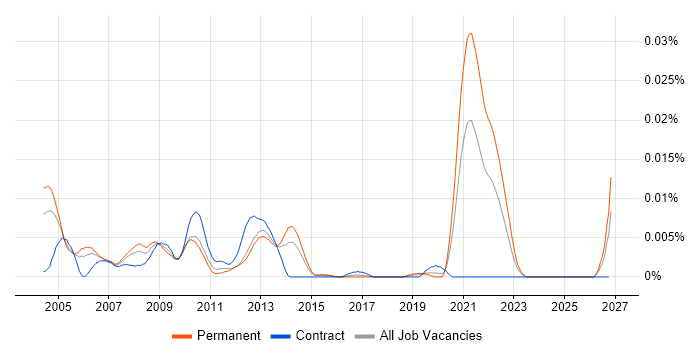
Historical trend showing the proportion of permanent DSP Algorithm Engineer job postings relative to all permanent IT jobs advertised in England.
DSP Algorithm Engineer Salary Trend in England
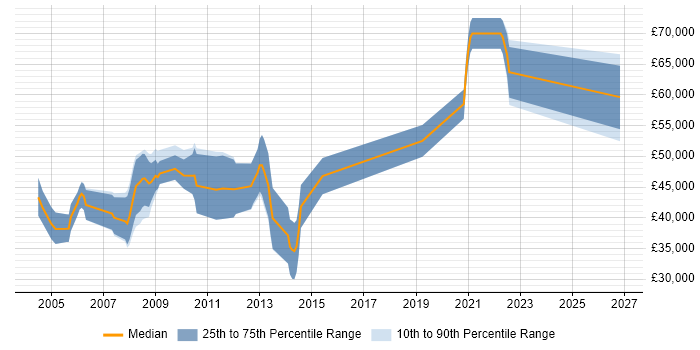
Salary distribution trend for DSP Algorithm Engineer job vacancies in England.
DSP Algorithm Engineer Salary Histogram in England
Salary distribution for DSP Algorithm Engineer jobs in England over the 6 months to 24 November 2026.
DSP Algorithm Engineer Job Locations in England
The table below looks at the demand and provides a guide to the median salaries quoted in DSP Algorithm Engineer jobs within the England region over the 6 months to 24 November 2026. The 'Rank Change' column provides an indication of the change in demand within each location based on the same 6 month period last year.
| Location | Rank Change on Same Period Last Year |
Job Ads Past 6 Months |
Median Salary Past 6 Months |
Median Salary % Change on Same Period Last Year |
Live Jobs |
|---|---|---|---|---|---|
| South East | - | 2 | £50,500 | - | 4 |
| DSP Algorithm Engineer UK |
|||||
DSP Algorithm Engineer Skill Set Top 28 Co-Occurring Skills & Capabilities in England
For the 6 months to 24 November 2026, DSP Algorithm Engineer job ads cited the following skills and capabilities in order of popularity. The figures indicate the absolute number of co-occurrences and as a proportion of all permanent DSP Algorithm Engineer job ads across the England region.
| Rank | Skill | Share | Job Ads |
|---|---|---|---|
| 1 | Agile | 100.0% | 2 |
| 1 | C | 100.0% | 2 |
| 1 | C++ | 100.0% | 2 |
| 1 | Data Analysis | 100.0% | 2 |
| 1 | Degree | 100.0% | 2 |
| 1 | Digital Signal Processing | 100.0% | 2 |
| 1 | Embedded C | 100.0% | 2 |
| 1 | Embedded C++ | 100.0% | 2 |
| 1 | Firmware | 100.0% | 2 |
| 1 | IC Design | 100.0% | 2 |
| 1 | Kalman Filter | 100.0% | 2 |
| 1 | Machine Learning | 100.0% | 2 |
| 1 | Master's Degree | 100.0% | 2 |
| 1 | MATLAB | 100.0% | 2 |
| 1 | PhD | 100.0% | 2 |
| 1 | Physics | 100.0% | 2 |
| 1 | Python | 100.0% | 2 |
| 1 | Signal Processing | 100.0% | 2 |
| 1 | Validation | 100.0% | 2 |
| 20 | Embedded Firmware | 50.0% | 1 |
| 20 | FPGA Design | 50.0% | 1 |
| 20 | Mathematics | 50.0% | 1 |
| 20 | Mentoring | 50.0% | 1 |
| 20 | Postgraduate | 50.0% | 1 |
| 20 | Problem-Solving | 50.0% | 1 |
| 20 | Prototyping | 50.0% | 1 |
| 20 | Sensor Fusion | 50.0% | 1 |
| 20 | Simulink | 50.0% | 1 |
DSP Algorithm Engineer Skill Set Co-Occurring Skills & Capabilities in England by Category
The table below expands on the one above by listing co-occurrences one category at a time. It covers the same employment type, locality and period, with up to 20 co-occurrences in each category.
Job Titles
| Rank | Job Title | Share | Job Ads |
|---|---|---|---|
| 1 | Research Engineer | 100.0% | 2 |
| 2 | Senior Algorithm Engineer | 50.0% | 1 |
| 2 | Senior DSP Engineer | 50.0% | 1 |
| 2 | Senior Systems Engineer | 50.0% | 1 |