
Hybrid/Remote Perl Job Trends

Perl
UK > Work from Home

The table below provides summary statistics and salary benchmarking for remote or hybrid work requiring Perl skills. It covers permanent job vacancies from the 6 months leading up to 23 December 2025, with comparisons to the same periods in the previous two years.

6 months to
23 Dec 2025
Same period 2024 Same period 2023
Rank 356 374 340
Rank change year-on-year +18 -34 +87
Permanent jobs citing Perl 21 57 120
As % of all permanent jobs with remote/hybrid work options 0.14% 0.33% 0.61%
As % of the Programming Languages category 0.50% 0.78% 1.31%
Number of salaries quoted 19 34 85
10th Percentile £47,500 £52,875 £40,832
25th Percentile £50,000 £67,500 £50,000
Median annual salary (50th Percentile) £72,500 £85,253 £70,000
Median % change year-on-year -14.96% +21.79% -
75th Percentile £76,250 £112,500 £83,750
90th Percentile - - £102,500
UK median annual salary £58,000 £72,500 £70,000
% change year-on-year -20.00% +3.57% -

All Programming Languages
Work from Home

Perl falls under the Programming Languages category. For comparison with the information above, the following table provides summary statistics for all permanent job vacancies with remote or hybrid options requiring coding skills.

Permanent vacancies with a requirement for coding skills 4,161 7,339 9,184
As % of all permanent jobs with a WFH option 27.22% 42.56% 46.69%
Number of salaries quoted 3,183 4,711 7,764
10th Percentile £36,250 £39,000 £40,000
25th Percentile £46,750 £48,625 £48,750
Median annual salary (50th Percentile) £62,500 £65,000 £62,500
Median % change year-on-year -3.85% +4.00% -3.85%
75th Percentile £83,750 £84,964 £83,750
90th Percentile £110,000 £110,000 £102,500
UK median annual salary £62,500 £65,000 £65,000
% change year-on-year -3.85% - -

Perl
Job Vacancy Trend for Remote/Hybrid Jobs

Historical trend showing the proportion of permanent IT job postings citing Perl and offering remote or hybrid work options relative to all permanent IT jobs advertised.
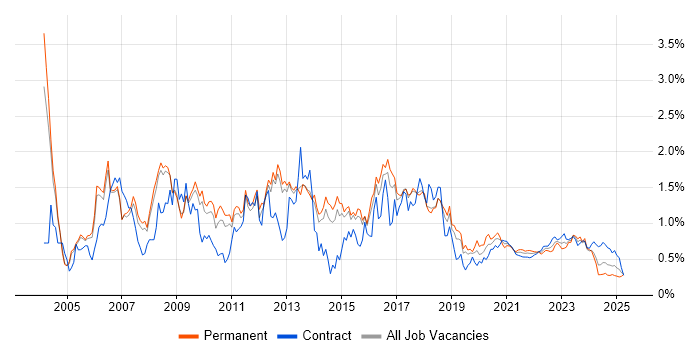
Perl job vacancy trend for remote/hybrid jobs

Perl
Salary Trend for Remote/Hybrid Jobs

Salary distribution trend for jobs with remote/hybrid work options citing Perl.
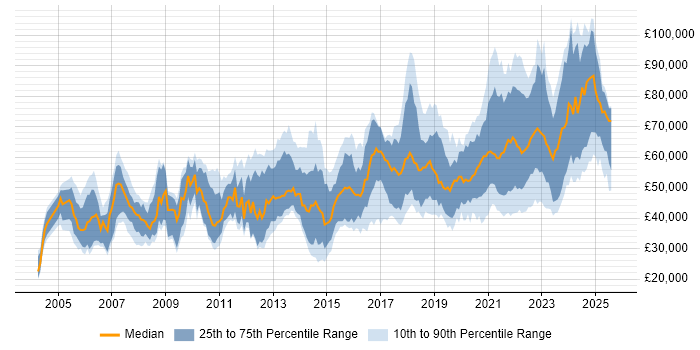
Salary distribution trend for jobs with remote/hybrid work options citing Perl

Perl
Salary Histogram for Remote/Hybrid Jobs

Salary distribution for jobs with remote/hybrid work options citing Perl over the 6 months to 23 December 2025.

Perl salary histogram for jobs with remote/hybrid work options

Perl
Co-Occurring Skills & Capabilities in Remote/Hybrid Jobs by Category

The following tables expand on the one above by listing co-occurrences grouped by category. They cover the same employment type, locality and period, with up to 20 co-occurrences shown in each category:

Application Platforms
1 3 (14.29%) Apache
2 2 (9.52%) nginx
3 1 (4.76%) Apache Solr
3 1 (4.76%) OpenStack
Cloud Services
1 2 (9.52%) Azure
2 1 (4.76%) Azure DevOps
Communications & Networking
1 2 (9.52%) DHCP
1 2 (9.52%) DNS
1 2 (9.52%) LAN
1 2 (9.52%) NAS
1 2 (9.52%) SAN
1 2 (9.52%) SNMP
1 2 (9.52%) TCP/IP
1 2 (9.52%) WAN
Database & Business Intelligence
1 2 (9.52%) MySQL
2 1 (4.76%) Elasticsearch
Development Applications
1 3 (14.29%) Git
2 1 (4.76%) GitLab
General
1 12 (57.14%) Finance
2 8 (38.10%) Social Skills
3 1 (4.76%) Banking
3 1 (4.76%) Investment Banking
Job Titles
1 14 (66.67%) Linux Engineer
2 10 (47.62%) Automation Engineer
2 10 (47.62%) Platform Engineer
3 6 (28.57%) Developer
4 4 (19.05%) Applications Developer
4 4 (19.05%) Applications Support
5 3 (14.29%) Senior
6 2 (9.52%) Senior Linux Engineer
7 1 (4.76%) Administrator
7 1 (4.76%) DevOps Administrator
7 1 (4.76%) DevOps Engineer
7 1 (4.76%) DevOps Systems Engineer
7 1 (4.76%) Linux Administrator
7 1 (4.76%) Linux DevOps Administrator
7 1 (4.76%) Linux DevOps Engineer
7 1 (4.76%) Linux Systems Administrator
7 1 (4.76%) Linux Systems Engineer
7 1 (4.76%) Linux/Unix DevOps
7 1 (4.76%) Perl Developer
7 1 (4.76%) Systems Administrator
Libraries, Frameworks & Software Standards
1 4 (19.05%) XML
2 2 (9.52%) LAMP
2 2 (9.52%) LDAP
3 1 (4.76%) CSS
3 1 (4.76%) HTML
3 1 (4.76%) Node.js
3 1 (4.76%) REST
3 1 (4.76%) RESTful
Miscellaneous
1 2 (9.52%) FPGA
2 1 (4.76%) Legacy Systems
Operating Systems
1 21 (100.00%) Linux
2 3 (14.29%) CentOS
2 3 (14.29%) Red Hat Enterprise Linux
3 2 (9.52%) Oracle Linux
3 2 (9.52%) Unix
4 1 (4.76%) Debian
4 1 (4.76%) Solaris
4 1 (4.76%) Ubuntu
4 1 (4.76%) Windows
4 1 (4.76%) Windows Server
Processes & Methodologies
1 13 (61.90%) CI/CD
1 13 (61.90%) DevOps
2 11 (52.38%) Security Hardening
3 10 (47.62%) Data Security
3 10 (47.62%) Platform Engineering
4 5 (23.81%) ITIL
4 5 (23.81%) Problem-Solving
5 4 (19.05%) Incident Management
6 2 (9.52%) Computer Science
6 2 (9.52%) Containerisation
6 2 (9.52%) Continuous Improvement
6 2 (9.52%) Task Automation
6 2 (9.52%) Test Automation
7 1 (4.76%) API Integration
7 1 (4.76%) API Management
7 1 (4.76%) High Availability
7 1 (4.76%) Infrastructure Automation
7 1 (4.76%) Infrastructure Engineering
7 1 (4.76%) Machine Learning
7 1 (4.76%) Proactive Monitoring
Programming Languages
1 19 (90.48%) Python
2 12 (57.14%) Bash
3 6 (28.57%) JavaScript
4 2 (9.52%) Java
5 1 (4.76%) PHP
Qualifications
1 2 (9.52%) Computer Science Degree
1 2 (9.52%) Degree
2 1 (4.76%) ITIL Certification
2 1 (4.76%) LPIC
Quality Assurance & Compliance
1 11 (52.38%) GDPR
1 11 (52.38%) Sarbanes-Oxley
System Software
1 2 (9.52%) Docker
2 1 (4.76%) Virtual Machines
Systems Management
1 16 (76.19%) Ansible
2 12 (57.14%) Red Hat Satellite
3 2 (9.52%) Red Hat Spacewalk
3 2 (9.52%) Terraform
4 1 (4.76%) Kubernetes
4 1 (4.76%) Puppet
Vendors
1 13 (61.90%) Red Hat
2 2 (9.52%) Dell
2 2 (9.52%) HP
2 2 (9.52%) Oracle
3 1 (4.76%) Microsoft