
IT Analyst Job Trends in the East of England
IT Analyst
England > East of England
The median IT Analyst salary in the East of England is £32,500 per year, according to job vacancies posted during the 6 months leading to 27 October 2026.
The table below compares current salary benchmarking and summary statistics with the previous two years.
| 6 months to 27 Oct 2026 |
Same period 2025 | Same period 2024 | |
|---|---|---|---|
| Rank | 120 | 138 | 152 |
| Rank change year-on-year | +18 | +14 | -54 |
| Permanent IT Analyst jobs | 102 | 32 | 27 |
| As % of all permanent jobs in the East of England | 1.17% | 0.96% | 0.65% |
| As % of the Job Titles category | 1.28% | 1.05% | 0.68% |
| Number of salaries quoted | 87 | 24 | 8 |
| 10th Percentile | £25,000 | - | £24,200 |
| 25th Percentile | £28,000 | £26,250 | £25,813 |
| Median annual salary (50th Percentile) | £32,500 | £32,500 | £29,750 |
| Median % change year-on-year | - | +9.24% | +7.21% |
| 75th Percentile | £45,000 | £35,375 | £36,250 |
| 90th Percentile | £50,000 | £44,000 | £42,250 |
| England median annual salary | £33,500 | £32,750 | £37,500 |
| % change year-on-year | +2.29% | -12.67% | +4.90% |
All Permanent IT Job Roles
East of England
For comparison with the information above, the following table provides summary statistics for all permanent IT job adverts in the East of England matching a recognised job title. The table also shows what proportion of all permanent IT job adverts they make up.
| 6 months to 27 Oct 2026 |
Same period 2025 | Same period 2024 | |
|---|---|---|---|
| Permanent job adverts in the East of England matching a recognised job title | 7,987 | 3,041 | 3,946 |
| % of permanent job adverts matching a recognised job title | 91.23% | 91.54% | 94.31% |
| Number of salaries quoted | 5,658 | 1,793 | 2,037 |
| 10th Percentile | £30,000 | £27,000 | £28,000 |
| 25th Percentile | £37,500 | £31,250 | £40,000 |
| Median annual salary (50th Percentile) | £52,500 | £45,000 | £52,500 |
| Median % change year-on-year | +16.67% | -14.29% | - |
| 75th Percentile | £68,750 | £60,000 | £68,750 |
| 90th Percentile | £85,000 | £75,000 | £85,000 |
| England median annual salary | £59,999 | £53,000 | £57,500 |
| % change year-on-year | +13.21% | -7.83% | -4.17% |
IT Analyst Job Vacancy Trend in the East of England
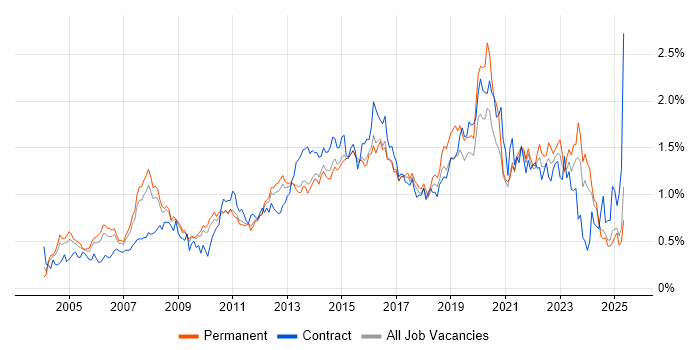
Historical trend showing the proportion of permanent IT Analyst job postings relative to all permanent IT jobs advertised in the East of England.
IT Analyst Salary Trend in the East of England
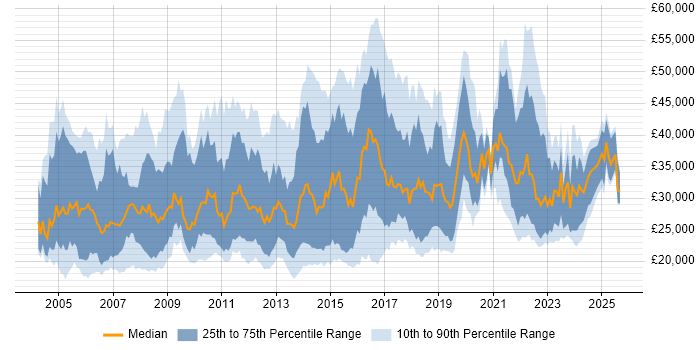
Salary distribution trend for IT Analyst job vacancies in the East of England.
IT Analyst Salary Histogram in the East of England
Salary distribution for IT Analyst jobs in the East of England over the 6 months to 27 October 2026.
IT Analyst Job Locations in the East of England
The table below looks at the demand and provides a guide to the median salaries quoted in IT Analyst jobs within the East of England region over the 6 months to 27 October 2026. The 'Rank Change' column provides an indication of the change in demand within each location based on the same 6 month period last year.
| Location | Rank Change on Same Period Last Year |
Job Ads Past 6 Months |
Median Salary Past 6 Months |
Median Salary % Change on Same Period Last Year |
Live Jobs |
|---|---|---|---|---|---|
| Hertfordshire | -12 | 32 | £37,500 | -12.79% | 1 |
| Essex | -6 | 29 | £25,250 | -15.83% | |
| Cambridgeshire | -12 | 22 | £34,000 | +13.33% | 1 |
| Bedfordshire | - | 13 | £41,739 | - | |
| Suffolk | - | 6 | £35,000 | - | 2 |
| IT Analyst England |
|||||
IT Analyst Skill Set Top 30 Co-Occurring Skills & Capabilities in the East of England
For the 6 months to 27 October 2026, IT Analyst job ads cited the following skills and capabilities in order of popularity. The figures indicate the absolute number of co-occurrences and as a proportion of all permanent IT Analyst job ads across the East of England region.
| Rank | Skill | Share | Job Ads |
|---|---|---|---|
| 1 | Microsoft | 42.2% | 43 |
| 2 | Microsoft 365 | 36.3% | 37 |
| 3 | Windows | 34.3% | 35 |
| 4 | Problem-Solving | 32.4% | 33 |
| 5 | Active Directory | 29.4% | 30 |
| 6 | Azure | 25.5% | 26 |
| 7 | Customer Service | 21.6% | 22 |
| 8 | ITIL | 20.6% | 21 |
| 9 | DHCP | 14.7% | 15 |
| 9 | DNS | 14.7% | 15 |
| 9 | Microsoft Intune | 14.7% | 15 |
| 12 | A+ Certification | 13.7% | 14 |
| 13 | Degree | 12.7% | 13 |
| 13 | Windows Server | 12.7% | 13 |
| 15 | Entra ID | 11.8% | 12 |
| 15 | SharePoint | 11.8% | 12 |
| 17 | Asset Management | 10.8% | 11 |
| 17 | ServiceNow | 10.8% | 11 |
| 19 | Continuous Improvement | 9.8% | 10 |
| 19 | Cybersecurity | 9.8% | 10 |
| 19 | ERP | 9.8% | 10 |
| 19 | Service Management | 9.8% | 10 |
| 19 | VoIP | 9.8% | 10 |
| 19 | VPN | 9.8% | 10 |
| 19 | Windows Server 2019 | 9.8% | 10 |
| 26 | Stakeholder Management | 8.8% | 9 |
| 27 | Service Delivery | 7.8% | 8 |
| 27 | TCP/IP | 7.8% | 8 |
| 29 | Business Analysis | 6.9% | 7 |
| 29 | Firewall | 6.9% | 7 |
IT Analyst Skill Set Co-Occurring Skills & Capabilities in the East of England by Category
The table below expands on the one above by listing co-occurrences one category at a time. It covers the same employment type, locality and period, with up to 20 co-occurrences in each category.
Job Titles
| Rank | Job Title | Share | Job Ads |
|---|---|---|---|
| 1 | IT Support Analyst | 56.9% | 58 |
| 2 | Support Analyst | 54.9% | 56 |
| 3 | Business IT Analyst | 14.7% | 15 |
| 4 | Senior Analyst | 11.8% | 12 |
| 5 | Service Desk Analyst | 9.8% | 10 |
| 6 | 1st Line Service Desk Analyst | 6.9% | 7 |
| 6 | IT Security Analyst | 6.9% | 7 |
| 8 | Graduate IT Support Analyst | 5.9% | 6 |
| 9 | IT Manager | 4.9% | 5 |
| 10 | 2nd Line Support Analyst | 3.9% | 4 |
| 10 | Change Analyst | 3.9% | 4 |
| 10 | IT Project Manager | 3.9% | 4 |
| 10 | Junior IT Support Analyst | 3.9% | 4 |
| 10 | Legal Analyst | 3.9% | 4 |
| 10 | Project Analyst | 3.9% | 4 |
| 10 | Systems Analyst | 3.9% | 4 |
| 17 | 1st Line Support Analyst | 2.9% | 3 |
| 17 | IT Support Assistant | 2.9% | 3 |
| 17 | Service Desk Support Analyst | 2.9% | 3 |
| 20 | Data Analyst | 2.0% | 2 |