
PL/SQL Contract Job Trends in London
PL/SQL (PLSQL)
England > London
The table below provides summary statistics and contractor rates for jobs advertised in London citing PL/SQL skills. It covers contract job vacancies from the 6 months leading up to 27 October 2026, with comparisons to the same periods in the previous two years.
| 6 months to 27 Oct 2026 |
Same period 2025 | Same period 2024 | |
|---|---|---|---|
| Rank | 302 | 243 | 192 |
| Rank change year-on-year | -59 | -51 | +1 |
| Contract jobs citing PL/SQL | 160 | 131 | 193 |
| As % of all contract jobs in London | 0.78% | 0.98% | 1.23% |
| As % of the Programming Languages category | 2.46% | 2.55% | 3.14% |
| Number of daily rates quoted | 99 | 99 | 137 |
| 10th Percentile | £404 | £385 | £363 |
| 25th Percentile | £416 | £404 | £385 |
| Median daily rate (50th Percentile) | £525 | £500 | £475 |
| Median % change year-on-year | +5.00% | +5.26% | +3.83% |
| 75th Percentile | £650 | £584 | £600 |
| 90th Percentile | £725 | £640 | £738 |
| England median daily rate | £530 | £500 | £500 |
| % change year-on-year | +5.95% | - | - |
| Number of hourly rates quoted | 0 | 2 | 0 |
| Median hourly rate | - | £83.75 | - |
| England median hourly rate | - | £83.75 | - |
All Programming Languages
London
PL/SQL falls under the Programming Languages category. For comparison with the information above, the following table provides summary statistics for all contract job vacancies citing coding skills in London.
| 6 months to 27 Oct 2026 |
Same period 2025 | Same period 2024 | |
|---|---|---|---|
| Contract vacancies citing coding skills | 6,501 | 5,129 | 6,148 |
| As % of all contract jobs advertised in London | 31.86% | 38.21% | 39.31% |
| Number of daily rates quoted | 4,431 | 3,457 | 4,235 |
| 10th Percentile | £375 | £373 | £370 |
| 25th Percentile | £444 | £430 | £463 |
| Median daily rate (50th Percentile) | £550 | £550 | £565 |
| Median % change year-on-year | - | -2.65% | -4.24% |
| 75th Percentile | £669 | £675 | £700 |
| 90th Percentile | £763 | £800 | £838 |
| England median daily rate | £525 | £513 | £539 |
| % change year-on-year | +2.44% | -4.96% | -1.95% |
| Number of hourly rates quoted | 48 | 71 | 42 |
| 10th Percentile | £29.43 | £23.45 | £35.08 |
| 25th Percentile | £36.25 | £32.06 | £40.06 |
| Median hourly rate | £52.75 | £43.50 | £48.50 |
| Median % change year-on-year | +21.26% | -10.31% | -11.82% |
| 75th Percentile | £65.00 | £62.88 | £71.66 |
| 90th Percentile | £88.75 | £87.50 | £97.50 |
| England median hourly rate | £65.00 | £62.50 | £65.00 |
| % change year-on-year | +4.00% | -3.85% | +4.00% |
PL/SQL Job Vacancy Trend in London
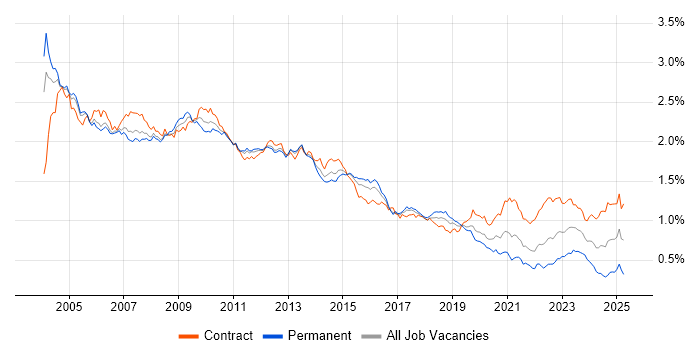
Historical trend showing the proportion of contract IT job postings citing PL/SQL relative to all contract IT jobs advertised in London.
PL/SQL Daily Rate Trend in London
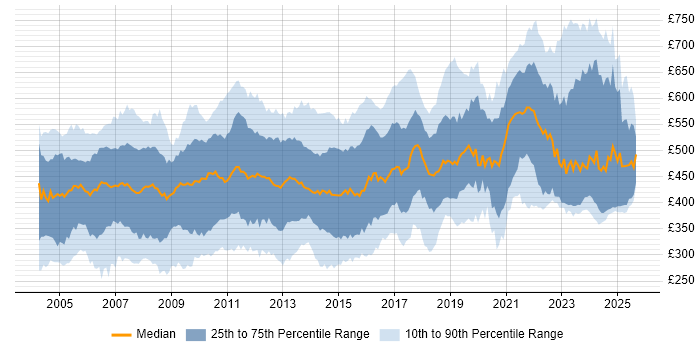
Contractor daily rate distribution trend for jobs in London citing PL/SQL.
PL/SQL Daily Rate Histogram in London
Daily rate distribution for jobs citing PL/SQL in London over the 6 months to 27 October 2026.
PL/SQL Hourly Rate Trend in London
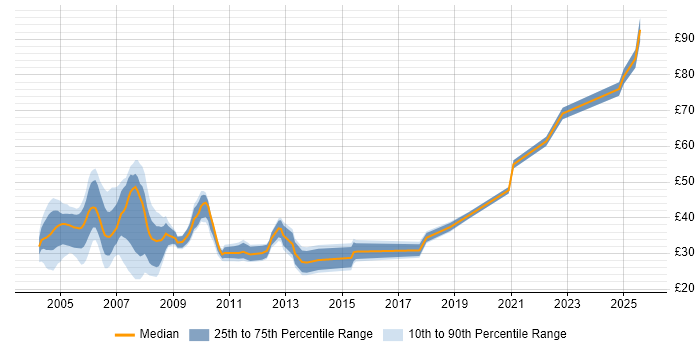
Contractor hourly rate distribution trend for jobs in London citing PL/SQL.
PL/SQL Contract Job Locations in London
The table below looks at the demand and provides a guide to the median contractor rates quoted in IT jobs citing PL/SQL within the London region over the 6 months to 27 October 2026. The 'Rank Change' column provides an indication of the change in demand within each location based on the same 6 month period last year.
| Location | Rank Change on Same Period Last Year |
Job Ads Past 6 Months |
Median Daily Rate Past 6 Months |
Median Daily Rate % Change on Same Period Last Year |
Live Jobs |
|---|---|---|---|---|---|
| Central London | -15 | 19 | £610 | +28.42% | 5 |
| South London | - | 6 | £800 | - | 2 |
| PL/SQL England |
|||||
PL/SQL Co-Occurring Skills & Capabilities in London by Category
The table below expands on the one above by listing co-occurrences one category at a time. It covers the same employment type, locality and period, with up to 20 co-occurrences in each category.