
Hybrid/Remote Virtual Desktop Job Trends
Virtual Desktop
UK > Work from Home
The table below provides summary statistics and salary benchmarking for remote/hybrid jobs citing Virtual Desktop skills. It covers permanent job vacancies from the 6 months leading up to 27 October 2026, with comparisons to the same periods in the previous two years.
| 6 months to 27 Oct 2026 |
Same period 2025 | Same period 2024 | |
|---|---|---|---|
| Rank | 413 | 374 | 380 |
| Rank change year-on-year | -39 | +6 | 0 |
| Permanent jobs citing Virtual Desktop | 56 | 45 | 86 |
| As % of all permanent jobs with remote/hybrid work options | 0.22% | 0.28% | 0.43% |
| As % of the System Software category | 2.93% | 2.51% | 3.15% |
| Number of salaries quoted | 37 | 17 | 66 |
| 10th Percentile | £38,500 | £44,400 | £41,875 |
| 25th Percentile | £40,000 | £57,500 | £55,000 |
| Median annual salary (50th Percentile) | £60,000 | £63,950 | £67,500 |
| Median % change year-on-year | -6.18% | -5.26% | +12.50% |
| 75th Percentile | £72,500 | £78,750 | £85,000 |
| 90th Percentile | £85,000 | £91,500 | - |
| UK median annual salary | £50,000 | £55,000 | £55,500 |
| % change year-on-year | -9.09% | -0.90% | -5.93% |
All System Software Skills
Work from Home
Virtual Desktop falls under the System Software category. For comparison with the information above, the following table provides summary statistics for all permanent job vacancies with remote/hybrid work options citing system software skills.
| 6 months to 27 Oct 2026 |
Same period 2025 | Same period 2024 | |
|---|---|---|---|
| Permanent vacancies citing system software skills | 1,910 | 1,790 | 2,732 |
| As % of all permanent jobs with remote/hybrid work options | 7.49% | 11.11% | 13.67% |
| Number of salaries quoted | 1,396 | 965 | 1,617 |
| 10th Percentile | £31,250 | £28,500 | £31,250 |
| 25th Percentile | £42,500 | £36,250 | £41,250 |
| Median annual salary (50th Percentile) | £60,000 | £52,500 | £57,500 |
| Median % change year-on-year | +14.29% | -8.70% | -4.17% |
| 75th Percentile | £73,750 | £72,500 | £75,000 |
| 90th Percentile | £87,500 | £85,000 | £90,000 |
| UK median annual salary | £55,000 | £49,000 | £55,000 |
| % change year-on-year | +12.24% | -10.91% | - |
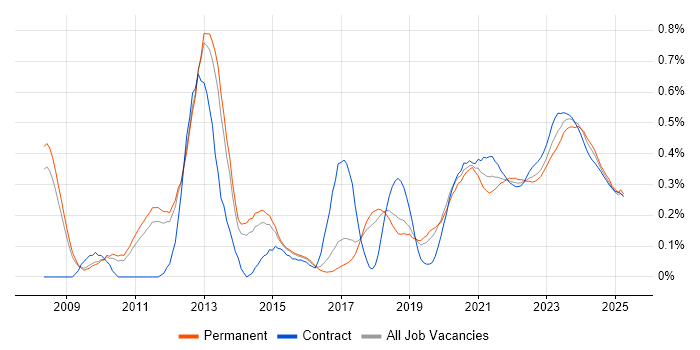
Virtual Desktop Job Vacancy Trend for Remote/Hybrid Jobs
Historical trend showing the proportion of permanent IT job postings citing Virtual Desktop and offering remote/hybrid work options relative to all permanent IT jobs advertised.
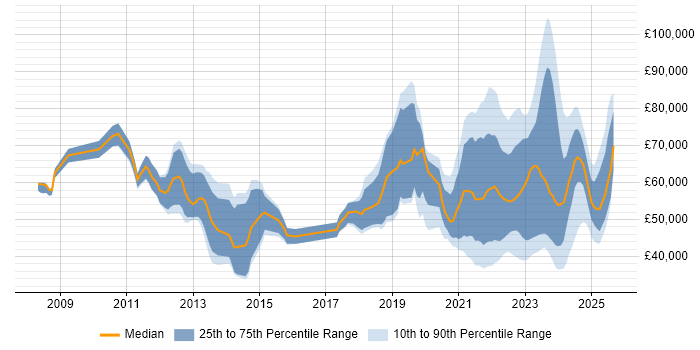
Virtual Desktop Salary Trend for Remote/Hybrid Jobs
Salary distribution trend for jobs with remote/hybrid work options citing Virtual Desktop.
Virtual Desktop Salary Histogram for Remote/Hybrid Jobs
Salary distribution for jobs with remote/hybrid work options citing Virtual Desktop over the 6 months to 27 October 2026.
Virtual Desktop Co-Occurring Skills & Capabilities in Remote/Hybrid Jobs by Category
The table below expands on the one above by listing co-occurrences one category at a time. It covers the same employment type, locality and period, with up to 20 co-occurrences in each category.
System Software
| Rank | Skill | Share | Job Ads |
|---|---|---|---|
| 1 | Active Directory | 55.4% | 31 |
| 2 | VMware Infrastructure | 32.1% | 18 |
| 3 | vSphere | 21.4% | 12 |
| 4 | Hyper-V | 16.1% | 9 |
| 5 | Virtual Machines | 10.7% | 6 |
| 6 | Docker | 3.6% | 2 |