
Hybrid/Remote Full-Stack Developer Job Trends
Full-Stack Developer
UK > Work from Home
The median Full-Stack Developer salary for remote/hybrid work is £60,000 per year, according to job vacancies posted during the 6 months leading to 27 October 2026.
The table below compares current salary benchmarking and summary statistics with the previous two years.
| 6 months to 27 Oct 2026 |
Same period 2025 | Same period 2024 | |
|---|---|---|---|
| Rank | 189 | 262 | 199 |
| Rank change year-on-year | +73 | -63 | -59 |
| Permanent Full-Stack Developer jobs | 343 | 159 | 324 |
| As % of all permanent jobs with remote/hybrid work options | 1.34% | 0.99% | 1.62% |
| As % of the Job Titles category | 1.43% | 1.04% | 1.68% |
| Number of salaries quoted | 287 | 126 | 208 |
| 10th Percentile | £45,000 | £40,000 | £40,000 |
| 25th Percentile | £52,500 | £45,000 | £45,000 |
| Median annual salary (50th Percentile) | £60,000 | £60,000 | £55,000 |
| Median % change year-on-year | - | +9.09% | -18.52% |
| 75th Percentile | £92,500 | £77,500 | £66,750 |
| 90th Percentile | £100,000 | £97,500 | £77,500 |
| UK median annual salary | £60,000 | £60,000 | £60,000 |
| % change year-on-year | - | - | -11.11% |
All Permanent IT Job Roles
Work from Home
For comparison with the information above, the following table provides summary statistics for all permanent IT job adverts with remote/hybrid work options and matching a recognised job title. The table also shows what proportion of all permanent IT job adverts they make up.
| 6 months to 27 Oct 2026 |
Same period 2025 | Same period 2024 | |
|---|---|---|---|
| Permanent remote/hybrid job adverts matching a recognised job title | 23,986 | 15,252 | 19,303 |
| % of permanent job adverts matching a recognised job title | 94.02% | 94.63% | 96.62% |
| Number of salaries quoted | 16,244 | 8,706 | 12,126 |
| 10th Percentile | £35,000 | £29,000 | £35,000 |
| 25th Percentile | £45,000 | £40,000 | £45,000 |
| Median annual salary (50th Percentile) | £60,000 | £56,500 | £60,000 |
| Median % change year-on-year | +6.19% | -5.83% | -4.00% |
| 75th Percentile | £80,000 | £77,500 | £80,000 |
| 90th Percentile | £100,000 | £97,500 | £100,000 |
| UK median annual salary | £59,490 | £52,500 | £57,000 |
| % change year-on-year | +13.31% | -7.89% | -5.00% |
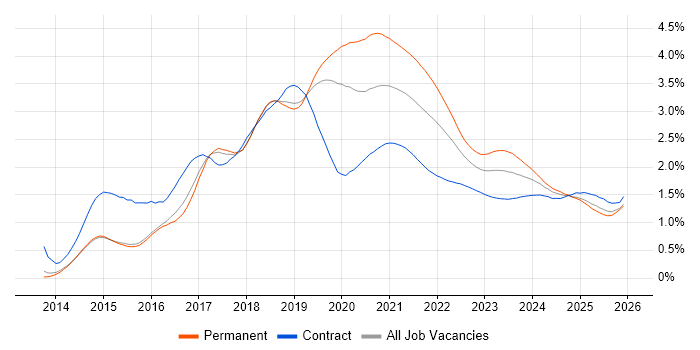
Full-Stack Developer Job Vacancy Trend for Remote/Hybrid Roles
Historical trend showing the proportion of permanent Full-Stack Developer job postings offering remote/hybrid work options relative to all permanent IT jobs advertised.
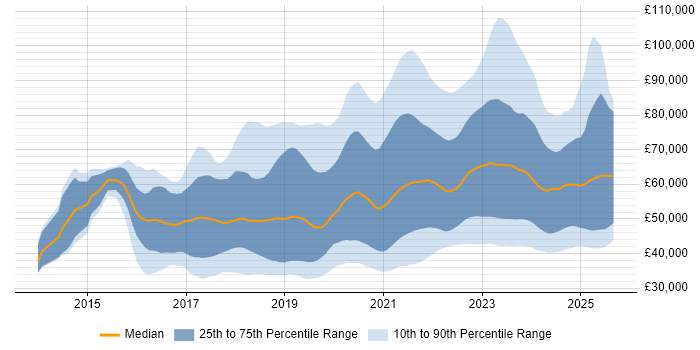
Full-Stack Developer Salary Trend for Remote/Hybrid Jobs
Salary distribution trend for remote/hybrid Full-Stack Developer job vacancies.
Full-Stack Developer Salary Histogram for Remote/Hybrid Jobs
Salary distribution for Full-Stack Developer jobs with remote/hybrid work options over the 6 months to 27 October 2026.
Full-Stack Developer Skill Set Top 30 Co-Occurring Skills & Capabilities in Remote/Hybrid Jobs
For the 6 months to 27 October 2026, Full-Stack Developer job ads cited the following skills and capabilities in order of popularity. The figures indicate the absolute number of co-occurrences and as a proportion of all permanent Full-Stack Developer jobs with remote/hybrid work options.
| Rank | Skill | Share | Job Ads |
|---|---|---|---|
| 1 | Full-Stack Development | 100.0% | 343 |
| 2 | JavaScript | 55.1% | 189 |
| 3 | TypeScript | 45.2% | 155 |
| 4 | React | 39.9% | 137 |
| 5 | AWS | 34.7% | 119 |
| 5 | Node.js | 34.7% | 119 |
| 7 | Microservices | 26.8% | 92 |
| 8 | SaaS | 24.8% | 85 |
| 9 | Agile | 23.3% | 80 |
| 9 | CI/CD | 23.3% | 80 |
| 11 | AI | 23.0% | 79 |
| 12 | .NET | 17.2% | 59 |
| 13 | C# | 16.6% | 57 |
| 14 | PostgreSQL | 15.5% | 53 |
| 15 | Azure | 15.2% | 52 |
| 16 | Docker | 13.1% | 45 |
| 16 | Vue | 13.1% | 45 |
| 18 | SQL Server | 12.8% | 44 |
| 19 | Clean Code | 12.5% | 43 |
| 20 | Continuous Improvement | 12.2% | 42 |
| 21 | Software Engineering | 11.7% | 40 |
| 21 | SQL | 11.7% | 40 |
| 23 | Git | 11.4% | 39 |
| 23 | Microsoft | 11.4% | 39 |
| 25 | MongoDB | 11.1% | 38 |
| 25 | Serverless | 11.1% | 38 |
| 27 | Amazon S3 | 10.5% | 36 |
| 27 | AWS Lambda | 10.5% | 36 |
| 29 | REST | 9.6% | 33 |
| 30 | GitHub | 9.3% | 32 |
Full-Stack Developer Skill Set Co-Occurring Skills & Capabilities in Remote/Hybrid Jobs by Category
The table below expands on the one above by listing co-occurrences one category at a time. It covers the same employment type, locality and period, with up to 20 co-occurrences in each category.
Job Titles
| Rank | Job Title | Share | Job Ads |
|---|---|---|---|
| 1 | Software Developer | 25.1% | 86 |
| 2 | Lead Full-Stack Developer | 22.2% | 76 |
| 3 | Lead Software Developer | 19.5% | 67 |
| 4 | Senior Full-Stack Developer | 18.7% | 64 |
| 5 | Full-Stack .NET Developer | 12.8% | 44 |
| 6 | Full-Stack C# Developer | 5.8% | 20 |
| 7 | C# .NET Developer | 5.5% | 19 |
| 7 | Full-Stack Java Developer | 5.5% | 19 |
| 9 | React Developer | 5.0% | 17 |
| 10 | Full-Stack Python Developer | 4.1% | 14 |
| 11 | AWS Developer | 3.8% | 13 |
| 11 | Senior Python Developer | 3.8% | 13 |
| 13 | Full-Stack Web Developer | 3.2% | 11 |
| 14 | .NET Web Developer | 2.9% | 10 |
| 15 | Senior Java Developer | 2.0% | 7 |
| 16 | Full-Stack PHP Developer | 1.7% | 6 |
| 17 | .NET Software Developer | 1.5% | 5 |
| 17 | .NET Software Engineer | 1.5% | 5 |
| 17 | Azure Developer | 1.5% | 5 |
| 17 | C# Software Developer | 1.5% | 5 |