
Performance Monitoring Job Trends
Performance Monitoring
UK
The table below provides summary statistics and salary benchmarking for jobs citing Performance Monitoring skills. It covers permanent job vacancies from the 6 months leading up to 27 October 2026, with comparisons to the same periods in the previous two years.
| 6 months to 27 Oct 2026 |
Same period 2025 | Same period 2024 | |
|---|---|---|---|
| Rank | 558 | 441 | 484 |
| Rank change year-on-year | -117 | +43 | +20 |
| Permanent jobs citing Performance Monitoring | 266 | 234 | 269 |
| As % of all permanent jobs in the UK | 0.22% | 0.47% | 0.40% |
| As % of the Processes & Methodologies category | 0.30% | 0.54% | 0.48% |
| Number of salaries quoted | 139 | 152 | 148 |
| 10th Percentile | £31,000 | £35,536 | £37,250 |
| 25th Percentile | £44,481 | £42,375 | £41,250 |
| Median annual salary (50th Percentile) | £55,000 | £61,250 | £53,000 |
| Median % change year-on-year | -10.20% | +15.57% | -3.64% |
| 75th Percentile | £73,875 | £75,000 | £74,144 |
| 90th Percentile | £94,500 | £94,500 | £79,350 |
| UK excluding London median annual salary | £52,500 | £55,485 | £50,000 |
| % change year-on-year | -5.38% | +10.97% | -4.76% |
All Process & Methodology Skills
UK
Performance Monitoring falls under the Processes and Methodologies category. For comparison with the information above, the following table provides summary statistics for all permanent job vacancies citing process or methodology skills.
| 6 months to 27 Oct 2026 |
Same period 2025 | Same period 2024 | |
|---|---|---|---|
| Permanent vacancies citing process or methodology skills | 89,161 | 43,476 | 56,183 |
| As % of all permanent jobs advertised in the UK | 73.55% | 88.06% | 82.51% |
| Number of salaries quoted | 60,237 | 25,076 | 29,761 |
| 10th Percentile | £31,250 | £28,250 | £33,750 |
| 25th Percentile | £41,250 | £35,500 | £45,000 |
| Median annual salary (50th Percentile) | £60,000 | £53,725 | £60,000 |
| Median % change year-on-year | +11.68% | -10.46% | - |
| 75th Percentile | £77,500 | £75,000 | £78,750 |
| 90th Percentile | £100,000 | £95,000 | £97,500 |
| UK excluding London median annual salary | £55,000 | £45,500 | £54,000 |
| % change year-on-year | +20.88% | -15.74% | +2.86% |
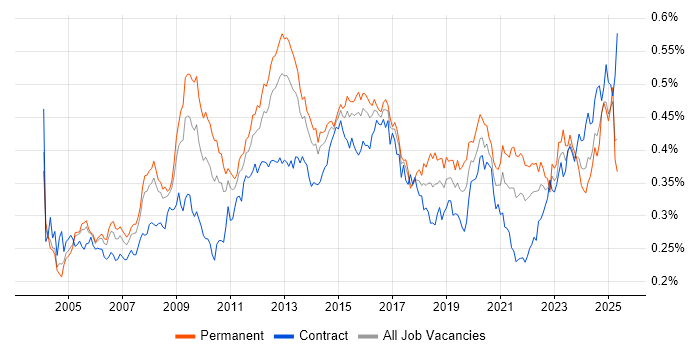
Performance Monitoring Job Vacancy Trend
Historical trend showing the proportion of permanent IT job postings citing Performance Monitoring relative to all permanent IT jobs advertised.
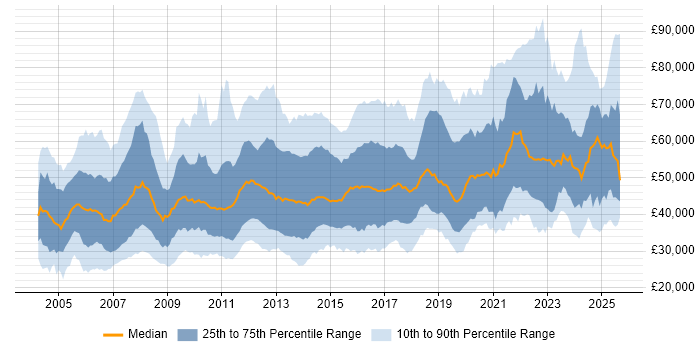
Performance Monitoring Salary Trend
Salary distribution trend for jobs in the UK citing Performance Monitoring.
Performance Monitoring Salary Histogram
Salary distribution for jobs citing Performance Monitoring over the 6 months to 27 October 2026.
Performance Monitoring Top 16 Job Locations
The table below looks at the demand and provides a guide to the median salaries quoted in IT jobs citing Performance Monitoring within the UK over the 6 months to 27 October 2026. The 'Rank Change' column provides an indication of the change in demand within each location based on the same 6 month period last year.
| Location | Rank Change on Same Period Last Year |
Job Ads Past 6 Months |
Median Salary Past 6 Months |
Median Salary % Change on Same Period Last Year |
Live Jobs |
|---|---|---|---|---|---|
| England | -113 | 237 | £59,623 | -4.60% | 51 |
| UK excluding London | -118 | 159 | £52,500 | -5.38% | 43 |
| London | -50 | 94 | £80,000 | +14.29% | 14 |
| Work from Home | -61 | 71 | £55,000 | -1.73% | 16 |
| South East | -60 | 46 | £59,250 | -8.85% | 10 |
| North of England | -78 | 39 | £55,768 | -14.20% | 6 |
| South West | -78 | 24 | £57,500 | +59.72% | 11 |
| Midlands | -70 | 18 | £47,500 | +18.75% | 10 |
| North West | -52 | 17 | £56,536 | -13.02% | 4 |
| Yorkshire | -29 | 15 | £34,000 | -47.69% | 1 |
| Scotland | +19 | 13 | £31,000 | -58.00% | 3 |
| East of England | -50 | 13 | £52,500 | -4.55% | 2 |
| West Midlands | -42 | 12 | £50,000 | -16.00% | 6 |
| North East | -57 | 7 | £70,000 | -5.15% | 1 |
| East Midlands | -48 | 6 | £37,750 | -5.63% | 4 |
| Wales | -69 | 6 | £52,500 | +18.41% | 1 |
Performance Monitoring Co-Occurring Skills & Capabilities by Category
The table below expands on the one above by listing co-occurrences one category at a time. It covers the same employment type, locality and period, with up to 20 co-occurrences in each category.
Processes & Methodologies
| Rank | Skill | Share | Job Ads |
|---|---|---|---|
| 1 | Continuous Improvement | 41.0% | 109 |
| 2 | Problem-Solving | 25.9% | 69 |
| 3 | Decision-Making | 22.9% | 61 |
| 4 | Analytics | 21.1% | 56 |
| 5 | DevOps | 19.5% | 52 |
| 6 | AI | 18.0% | 48 |
| 7 | Stakeholder Management | 17.3% | 46 |
| 8 | CI/CD | 16.5% | 44 |
| 9 | Agile | 15.4% | 41 |
| 9 | Observability | 15.4% | 41 |
| 11 | Infrastructure as Code | 14.7% | 39 |
| 12 | Mentoring | 14.3% | 38 |
| 13 | Risk Management | 12.8% | 34 |
| 14 | Incident Response | 11.7% | 31 |
| 15 | Coaching | 11.3% | 30 |
| 15 | Data Management | 11.3% | 30 |
| 17 | Architectural Patterns | 10.9% | 29 |
| 17 | Data Protection | 10.9% | 29 |
| 17 | Stakeholder Engagement | 10.9% | 29 |
| 20 | Roadmaps | 10.5% | 28 |